
Brumation is over. Everyone is eating. The days are getting longer. In a hognose household, that combination of things means one thing: it's time to start thinking about pairings.
For 2025, the plan was straightforward. Pair Bajsa with Albi, the same combination that gave us last year's clutch of 20 eggs and 16 healthy hatchlings. Proven pair, known genetics, no surprises. On March 3rd, we introduced them and settled in to watch.
What followed was not exactly straightforward.
Anyone who keeps hognose snakes knows that female introductions require attention, regardless of how many times you've done them before. Female western hognose snakes are significantly larger than males, and Bajsa in particular is not a small animal. She is also, as anyone who has followed her story will know, extremely food-motivated. That combination — size advantage, strong prey drive, and a male who is necessarily smaller — means the first moments of any introduction are the ones you watch most closely.
The risk of a female striking at a male is real, if relatively rare in hognose snakes compared to some other species. It tends to happen when the female isn't receptive and reads the male's movements as something other than a courting partner. The most effective way to assess receptivity quickly is to place the male directly onto the female rather than introducing him to the enclosure separately. The immediate physical contact gives you a read on her response within seconds rather than minutes.
Bajsa's response was immediate and unambiguous. The breeding twitch started almost before Albi had properly registered where he was. From a safety standpoint, that twitch is exactly what you want to see as quickly as possible. It tells you the female has no interest in treating the male as prey and that the conditions for courtship are in place.
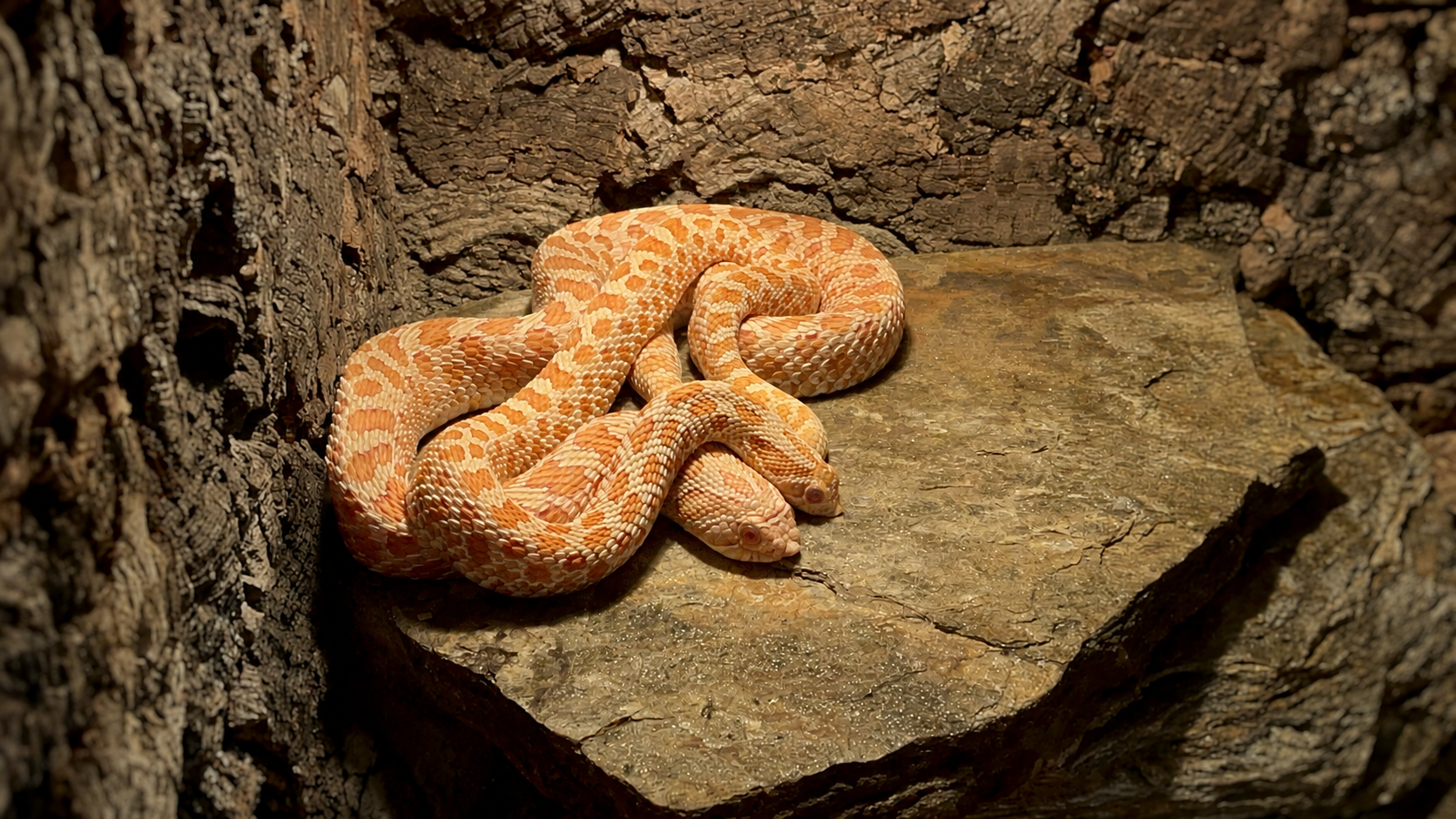
From there, it was Albi's turn. He showed interest. He tracked her scent, maintained contact, went through the early stages of courtship behavior. But over three days of observation, we never witnessed a lock.
The absence of an observed lock doesn't necessarily mean nothing happened. Hognose snakes are perfectly capable of mating overnight, in the early hours of the morning, or during any of the many windows when we weren't actively watching. A lock that happens at 3am looks exactly the same as one that doesn't happen at all, from a keeper's perspective. But without confirmation, you're working with uncertainty. And uncertainty is a less comfortable place to be when you're planning around a clutch.
After three days, we separated them, gave both animals a meal, and regrouped.
A week later, we made a decision that had been sitting in the background since brumation ended: give Hoggy a chance.
Hoggy had come through brumation in excellent condition and was eating well. We'd held off pairing him initially because Albi and Bajsa are a proven combination and Hoggy hadn't bred before. But with Albi's pairing unconfirmed and Hoggy clearly in good shape, it felt like the right moment.
We introduced Hoggy to Bajsa's enclosure with the same caution as always. Bajsa twitched immediately. Same clear, unambiguous signal as with Albi. And then Hoggy did something that genuinely surprised us: he responded almost instantly.
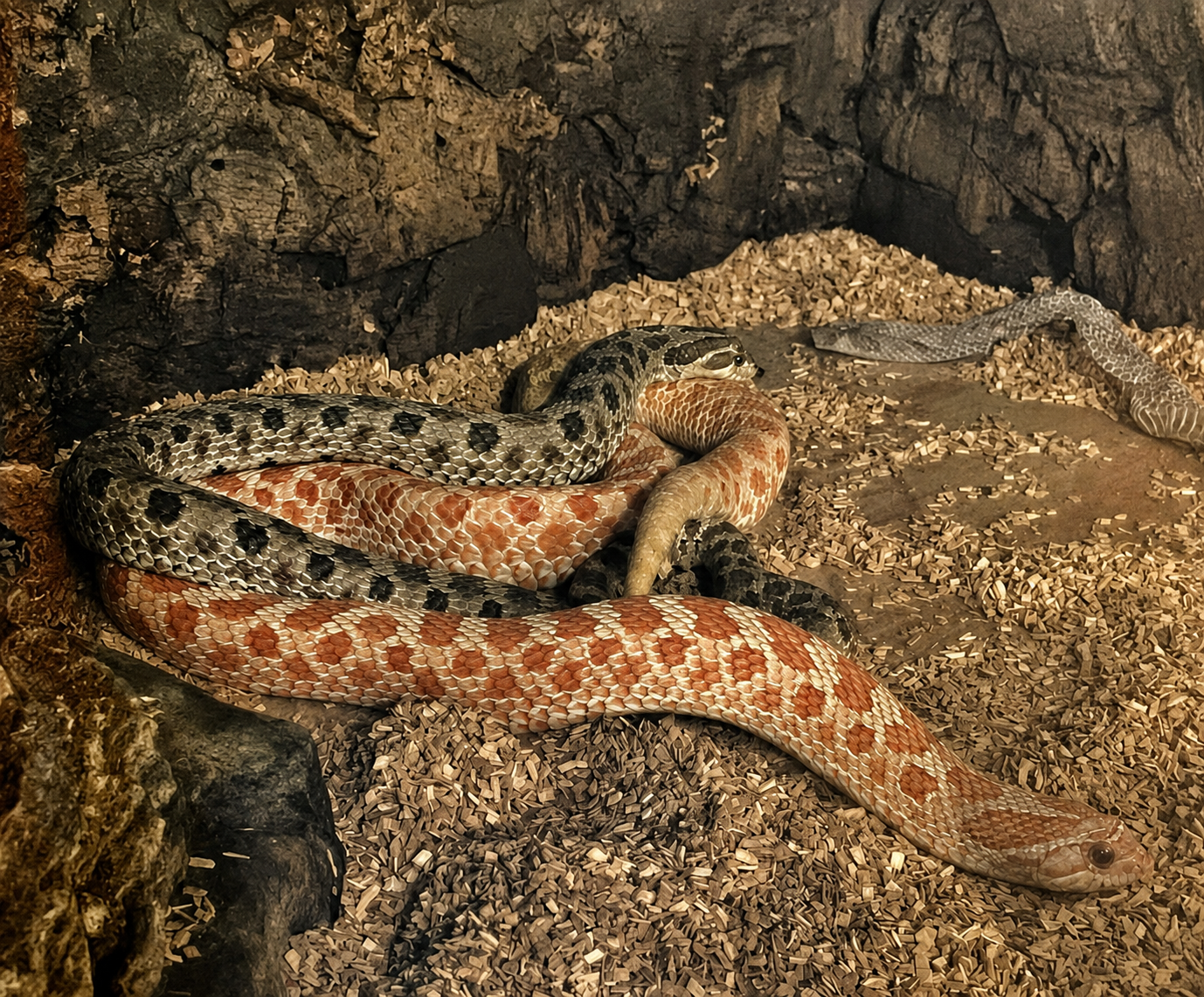
No extended tracking phase. No prolonged reassessment. He oriented toward Bajsa with purpose and moved into courtship behavior faster than we'd expected from a first-time male. Experience, it turns out, isn't the only thing that determines how a male performs. Some animals are simply more instinctively driven than others, and Hoggy, apparently, is one of them.
We left them together overnight and checked in the following morning.
Confirmed lock.
The pair had mated successfully. Hoggy's first ever breeding, and by all appearances a textbook one. By the time we checked on them, the lock had already ended and both animals were calm and separate. Hoggy was returned to his own enclosure, and Bajsa was given space to rest.
Here's where the 2025 season gets genuinely interesting: we don't know who the father is.
Albi was with Bajsa for three days. We never witnessed a lock, but that doesn't rule one out, and female hognose snakes are capable of storing viable sperm, so even a brief, unobserved mating could be sufficient for fertilization. Hoggy's lock, on the other hand, was confirmed.
If Bajsa produces a fertile clutch this season, it could be Hoggy's, Albi's, or theoretically both. Sperm from multiple males can fertilize eggs within the same clutch — a phenomenon called heteropaternity — and without genetic testing, we may not know for certain whose offspring we're looking at until the morphs reveal themselves at hatch.
What the hatchling morphs can potentially tell us: Albi is a visual albino het axanthic (the same combination as Bajsa), meaning offspring from that pairing could produce albinos and snow morphs. Hoggy, on the other hand, is a normal het albino. His offspring would be 50% normal het albino and 50% visual albino, with no snow possible since he doesn't carry axanthic. So the morph breakdown of the clutch is actually quite revealing: if we see snows, Albi is certainly involved. If we see only normals and albinos with no snows, that points strongly toward Hoggy. The hatchlings themselves will likely answer the question for us.
It's an unusual position to be in after a season that started with a clear plan. And honestly, it makes the next few months considerably more interesting to watch.
Bajsa has already had a substantial post-pairing meal with increased calcium supplementation. Egg production places significant demand on calcium reserves, and building that support in early is standard practice during gravid management.
From here, the watch begins. Over the coming weeks we'll be monitoring her body shape for the gradual rounding that indicates developing follicles, tracking changes in behavior and activity level, and paying close attention to her appetite as the gravid period progresses. The pre-lay shed is still weeks away if development is on schedule, but it's already the milestone we're counting toward.
Whatever this clutch turns out to be — Hoggy's first offspring, Albi's quietly confirmed contribution, or some combination of both — the 2025 season is already shaping up to be less predictable than we planned. Which, if last year taught us anything, is probably exactly how it was always going to go.

No comments yet — be the first.