
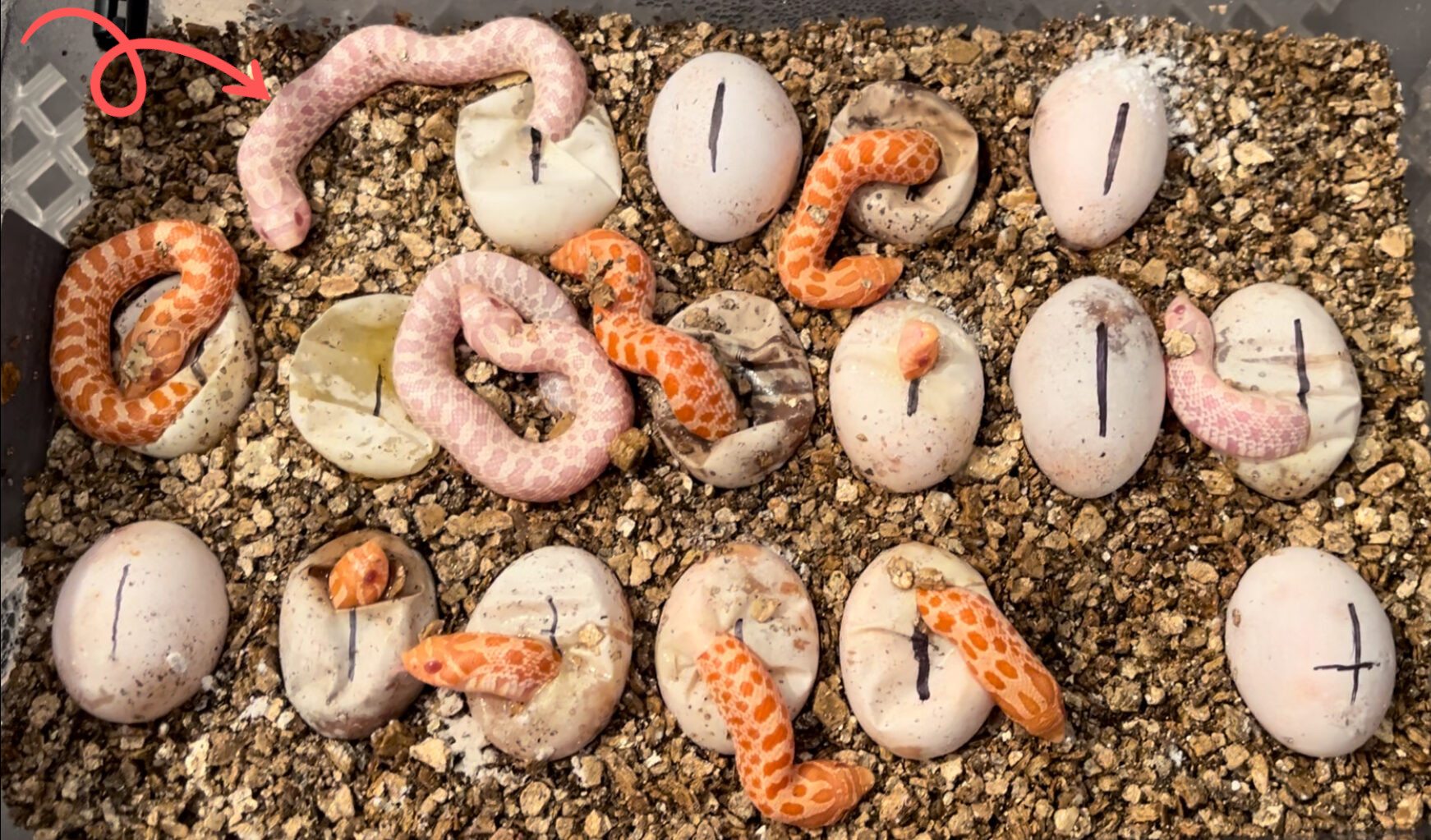
When the 2024 clutch hatched, we got three snows.
Three completely white hatchlings, exactly as they should be — clean, pale, with that particular quality that makes snow morphs so striking the first time you see them in person. All three looked identical coming out of the egg. We were happy with the result, and we moved on to the usual business of first sheds, first feeds, and watching the clutch settle into their temporary setups.
And then, slowly, one of them started to change.
It wasn't obvious at first. Snow hognose hatchlings can look slightly variable in their first weeks — the pattern fades, the color shifts a little as the new skin develops. We didn't think much of it initially.
But as the weeks passed and this particular female grew, it became clear that what was happening wasn't normal variation. She was getting darker. Not dramatically, not all at once, but consistently, steadily, in a direction none of her siblings were going. The white was taking on a warmth that deepened over time into something distinctly pinkish.
By the time she was a few months old, she didn't look like her clutchmates at all.
Here's the thing that made this even more interesting: cameras couldn't capture what was actually happening.
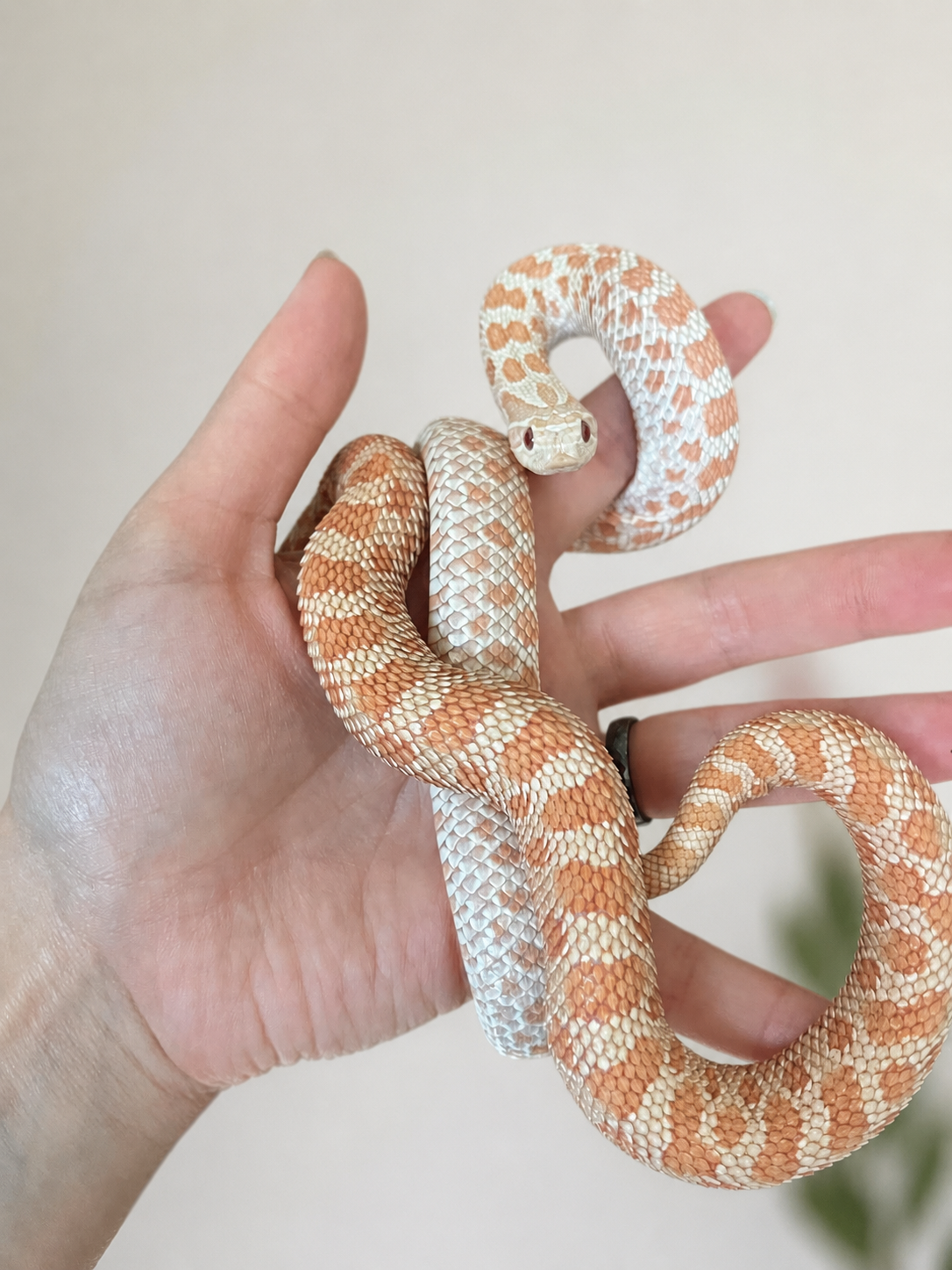
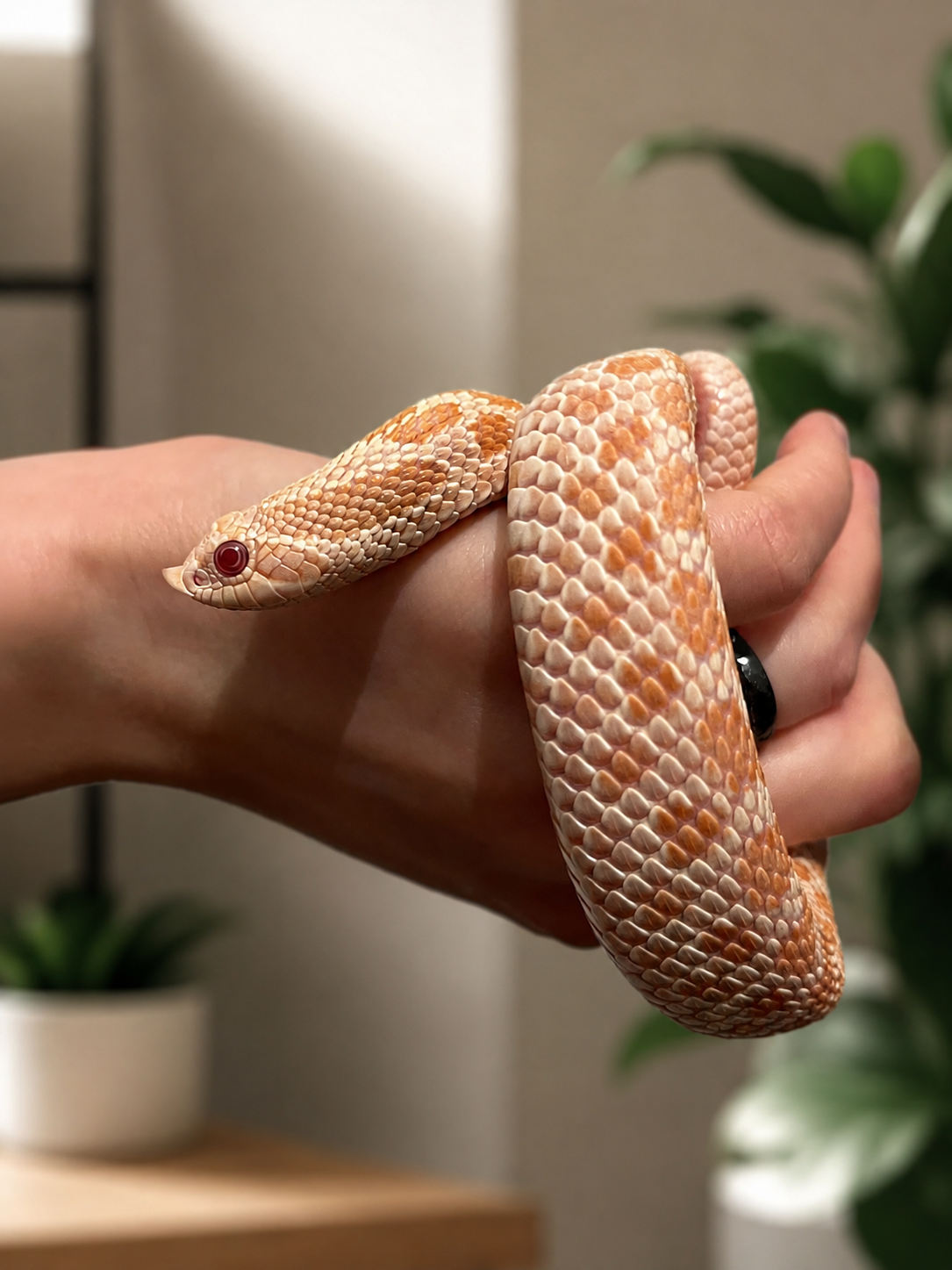
Every time we tried to photograph her to document the color change, the image came back showing something that looked like a very pale albino — washed out orange, slightly warm, but nothing that suggested what we were actually seeing with our own eyes. The real color, the one visible when you held her and looked at her directly, was pink. Genuinely, distinctly pink — not orange, not the warm cream of a standard albino, but a soft, rosy pink that's genuinely difficult to describe without seeing it.
We eventually found a Reddit post from another keeper describing exactly the same experience with a similarly colored snake and they noted the same thing. The photos don't show the true color. In the images, the snake looks like a pale albino. In person, it's something else entirely.
This took some research, and the honest answer is that it's not fully documented or widely discussed, which is part of why we wanted to write about it.
The working theory, supported by what others have observed with similarly colored animals, comes down to the genetics of the parents. Both Bajsa and Albi come from extreme red lines (a selective breeding focus that emphasizes the intensity and depth of red and orange pigmentation in albino animals). The extreme red trait isn't a simple on/off gene. It's the result of generations of selective pressure that amplifies the remaining pigment pathways in albino animals to produce deeper, more saturated coloration.
We've noticed this effect in our own albino hatchlings too. Not all albino babies from extreme red line parents look the same. Some come out with the standard warm orange you'd expect from a typical albino. Others are noticeably more saturated (a deeper, richer orange) that has a different quality to it even within the same clutch, from the same parents, hatched on the same day. It's not a dramatic difference, and it's not red in the way the name might suggest, more like the difference between a faded orange and a fully saturated one. But once you're looking for it, it's consistently visible. The extreme red genetics express differently across individual animals even when everything else is identical, and that variation is genuinely fascinating to observe clutch by clutch.
In a standard albino, melanin is absent but yellow and red pigments remain and express normally. In extreme red line animals, those remaining pigments are pushed further. Now take those genetics and combine them with the axanthic gene to produce a snow. The snow morph works by removing both melanin and yellow pigment, theoretically leaving a white animal. But if the underlying genetics are pushing red pigment expression harder than usual, the result may not be fully white. Some residual red expression bleeds through and in our female's case, it developed into something genuinely unexpected.
For a long time, we weren't sure what to do with her.
Selling her as a snow felt wrong — she wasn't going to look like a snow as an adult, and whoever bought her deserved to know what they were actually getting. But we also couldn't fully predict where her color was going to land. Every month she looked slightly different. The pink was deepening, settling, becoming more consistent, but the final picture wasn't clear yet.
So we held onto her. Watched her develop. Took photos that never quite captured what we were seeing and kept notes on what we were observing instead.
Eventually, the right home appeared. A friend who had been thinking about getting a hognose for a while, someone we knew well, someone who understood what they were taking on. He'd been considering an albino from our collection, but when we showed him this particular female and told him her story, he didn't hesitate.
He understood that she was something unusual. That the color she had wasn't in any morph guide. That she might keep developing in ways we couldn't fully predict. And he wanted her anyway — because of all of that, not despite it.
We were glad to find her a home like that. The kind where the story is part of what makes the animal special, not a complication to explain away.
If you're breeding snow morphs from extreme red line parents, this is worth being aware of, particularly because it seems to be underreported and the photography issue means it's easy to miss or misidentify.
A few things worth knowing:
It may not be visible at hatch. Our female looked identical to her white siblings when she first emerged. The color change developed gradually over weeks and months, not immediately.
Photos may not show it accurately. This is the detail that makes documentation difficult. If you're evaluating a snake's color from images alone (whether buying, selling, or just monitoring development) be aware that the pink tone in these animals doesn't photograph true. In images they often read as pale albino. In person the difference is visible.
It appears to be linked to extreme red genetics. This isn't confirmed through formal study, but the pattern of reports from other keepers with similarly colored animals points consistently in that direction. If both parents carry extreme red genetics and you're producing snows, it's worth watching the hatchlings over time rather than assuming the color you see at hatch is the color you'll have at adulthood.
It's not a health issue. The color change is purely cosmetic. A function of how the pigment genetics are expressing as the animal matures. There's nothing wrong with these animals. They're just doing something the genetics don't have a standard name for yet.
That's perhaps the most interesting thing about this whole experience. We have detailed genetic terminology for hundreds of hognose morphs and combinations. But what our female turned into doesn't have an established name or a recognized morph designation.
And honestly — in person, she's stunning. The color she developed isn't something you'd call orange, and it isn't the white you'd expect from a snow. It's a genuine, soft pink. Warm and delicate in a way that photographs simply refuse to show accurately. Images of her look like a pale albino. The reality is something considerably more special. A color that exists in that rare space between known morphs, produced by a combination of genetics that wasn't specifically aimed at creating it.
She went to a good home with someone who appreciated exactly that. We'll get updates. And we're genuinely curious to see what she looks like in another year, because with this particular animal, every few months has brought something new.
You must be logged in to post a comment.

No comments yet — be the first.