
Many western hognose snakes are enthusiastic, uncomplicated feeders. They smell prey, they strike, they eat. Done. If you have one of those, count yourself lucky and move on.
Then there are the others.
The ones that approach the prey item with apparent interest, tongue flick it thoroughly, and then simply walk away. The ones that have been fed successfully for months and then suddenly decide that particular prey item, on that particular evening, is completely unacceptable. The hatchlings that refuse everything for weeks while their siblings eat without hesitation.
Picky eating in hognose snakes is common enough that every keeper deals with it eventually, and frustrating enough that it's worth understanding properly. Not just what to try, but why certain approaches work and what the refusal is actually telling you.
Before trying any feeding technique, it's worth being honest about whether the refusal might be pointing to something that needs addressing rather than something to work around.
A snake that has been eating reliably and suddenly stops is a different situation from one that has always been a hesitant feeder. Sudden appetite loss in a previously consistent feeder warrants closer observation: check temperatures (a heat mat that's failing or a thermostat that's drifted can cause enclosure temps to drop enough to suppress appetite), look at humidity, observe the snake's behavior and body condition, and check for signs of an upcoming shed- Most snakes reduce or stop feeding in pre shed phase, which is completely normal.
Signs that warrant a vet visit rather than a feeding technique adjustment: persistent weight loss over multiple weeks, behavioral changes beyond just not eating (lethargy, unusual posture, open mouth breathing), or visible physical changes like swelling, discharge, or abnormal skin condition. A snake that's unwell will often refuse food, and trying to solve a health problem with scenting techniques isn't going to get you anywhere.
If the husbandry checks out and the snake is healthy — just not eating — then you're dealing with a picky eater, and here's how to approach it.
Western hognose snakes (Heterodon nasicus) are not obligate rodent specialists in the wild. Their natural diet leans heavily on amphibians. Frogs and toads are primary prey items, along with lizards and other small animals. Mice are convenient, nutritionally complete, and the standard captive prey item, but they don't necessarily match the instinctive prey profile that a hognose, particularly a young or wild-type one, is wired to recognize as food.
This is especially relevant for hatchlings. A freshly hatched hognose hasn't learned that mice are food. It's operating on instinct, and its instincts are tuned for something that smells and feels like an amphibian, not a rodent. Getting a hatchling over that initial recognition gap is often the entire challenge, and once it's made the association between mice and food, the problem typically resolves permanently.
Understanding this makes the standard techniques make sense rather than just feeling like a list of things to try randomly.
No feeding technique will work reliably if the enclosure conditions are wrong. This is worth stating plainly because it's easy to focus on what you're offering when the real problem is where and how you're offering it.
Temperature: the warm side surface should sit around 30–32°C (88–90°F), cool side at 22–24°C (72–76°F). A snake that's too cool won't have the metabolic drive to eat. Digestion requires warmth, and appetite follows. Verify your temperatures with a heat gun rather than relying on a thermostat reading alone.
Hides: at minimum one on the warm side and one on the cool side. A snake that feels exposed is a stressed snake, and stressed snakes don't eat reliably. Many picky eating problems in new setups resolve simply by adding an adequate hide on the warm end.
Handling frequency: too much handling, particularly in newly arrived animals or young snakes, suppresses appetite. If you've been handling regularly and feeding has become inconsistent, reducing handling and giving the snake several days of undisturbed time before the next feeding attempt is worth trying before anything else.
Prey left in the enclosure: some snakes simply prefer to eat unobserved. Place the prey item in the enclosure in the evening, leave the room, and check back after a few hours. Snakes that won't strike while you're watching will sometimes eat reliably when left alone. Always remove uneaten prey after a few hours. Leaving it overnight creates bacterial contamination risk and can stress the snake.
If a snake shows any interest in prey but doesn't follow through, try going smaller. A prey item that looks manageable triggers a feeding response more readily than one that seems overwhelming. For hatchlings especially, starting with the smallest available pinky (sometimes called a day-one pinky) removes one variable from the equation. Once feeding is established on smaller prey, you work the size up gradually over subsequent meals.
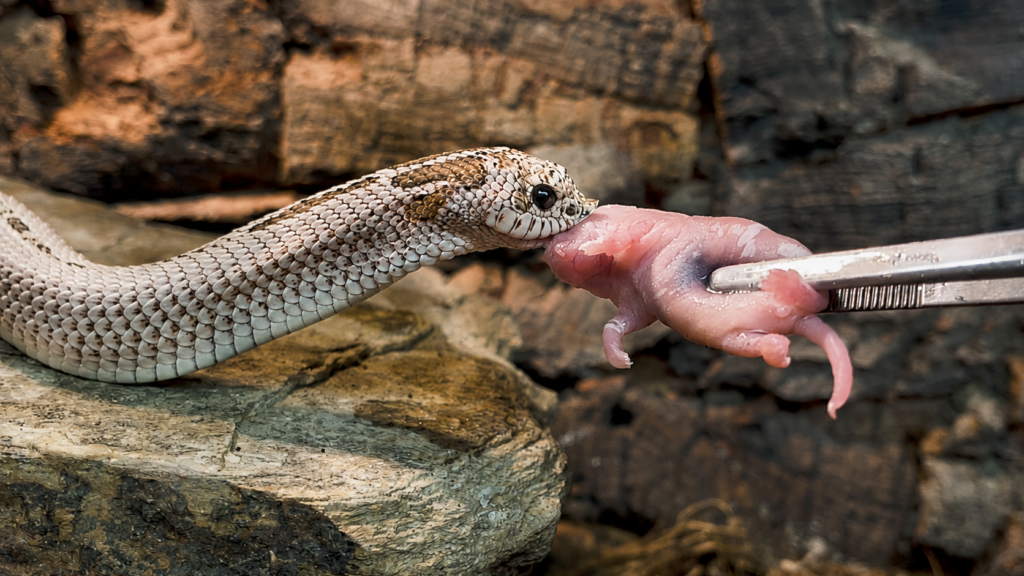
Scenting is the technique that resolves the majority of hognose feeding challenges, and it works by bridging the gap between what the snake's instincts say is food and what you're actually offering.
The principle is simple: transfer the scent of something the snake recognizes as prey onto the mouse or pinky. The snake's chemical detection system reads the familiar scent, triggers the feeding response, and the rest takes care of itself. Once the snake has eaten a scented item several times, it often begins to associate the mouse itself with food and the scenting becomes unnecessary.
Fish scenting is the most accessible starting point. Tuna, salmon, and sardines all work. Strong smelling fish in in natural oil (usually sunflower or olive) are particularly effective. Rub the thawed prey item on a piece of fish, or briefly dip it in the liquid from a can. The scent transfer only needs to be light. You're not marinating it, just coating it enough to change the chemical signal the snake detects.
Frog scenting products are available commercially and are specifically formulated to mimic the scent profile of amphibians. For a hognose that was wild-caught or comes from lines with strong wild-type instincts, frog scent can be more effective than fish.
Lizard scenting is a less commonly needed option but worth knowing about. Some individuals respond to lizard scent when fish and frog don't produce results.
A note on what we've seen in our own animals: the specific scenting agent that works for a given snake can be surprisingly individual. We've had hatchlings that took fish-scented pinkies immediately, and one — Hopper — who refused everything we tried for three months and eventually ate a piece of plain hake from a forgotten can in the back of the fridge. Sometimes the solution is genuinely unexpected. Keep trying different options before concluding that nothing will work.
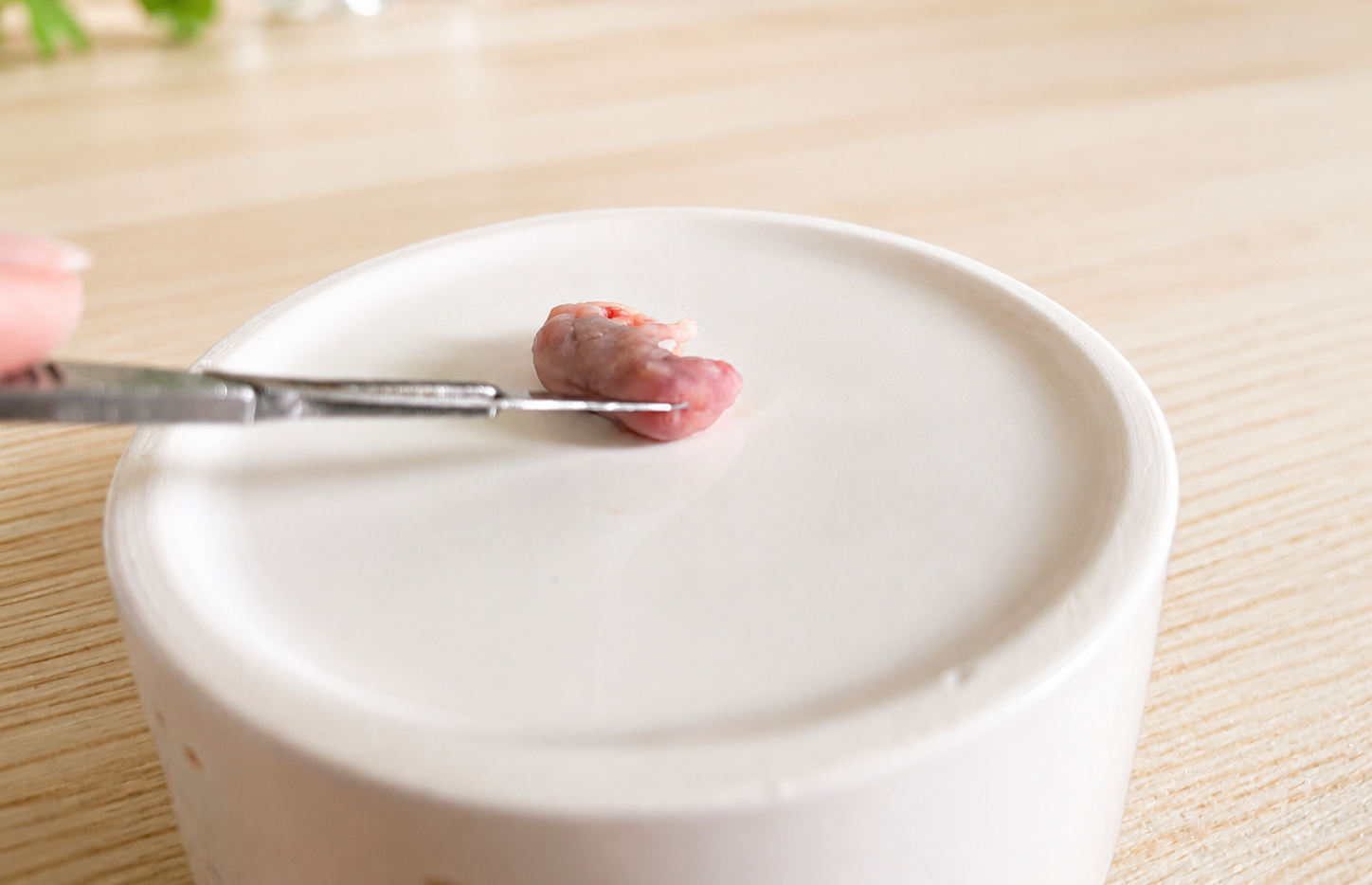
For persistently reluctant feeders, exposing the brain matter of a pinky by making a small incision at the skull is one of the most reliable triggers for a feeding response. It's not a pleasant technique to describe, but the biology behind it is sound: the scent of neural tissue is a particularly strong feeding stimulus for many snake species, including hognoses.
We've used this successfully with hatchlings that showed no response to standard scenting many times. Once a hatchling has eaten this way several times, you can gradually reduce the preparation and transition to plain scented prey, then eventually unscented.
How you present prey matters as much as what you're presenting. A few variables worth changing if standard tong feeding isn't working:
Try leaving prey in the enclosure rather than tong feeding. Some snakes are inhibited by the presence of a human or the movement of tongs and will only eat when left alone with the prey.
Warm the prey slightly before offering. A thawed pinky at room temperature is cooler than live prey would be. Warming it briefly in warm water to body temperature makes it a closer match to the thermal signature a hognose would detect in live prey.
Try feeding in a separate container. A small, dark feeding container removes the snake from its regular environment, which sometimes resets its behavior and produces a strike it wouldn't make in its home enclosure. This is particularly useful for snakes that seem aware they're being watched.
Move the prey slightly when tong feeding. A slight, irregular wiggle can trigger a strike response in a snake that's showing interest but not committing. Don't overdo it. Frantic movement can have the opposite effect, but subtle movement often makes the difference.
Live prey triggers instinctive responses that frozen-thawed prey sometimes doesn't — the movement, the warmth, and the behavior of live prey can reach snakes that don't respond to anything else.
The practical limit here: use live pinkies only, which are small enough and without teeth or claws, and supervise the feeding without exception. A live pinky that isn't eaten within 20 to 30 minutes should be removed. The goal is to get the strike and feeding response established on live pinkies, then transition to frozen-thawed as quickly as possible. Live prey as a permanent feeding method isn't necessary once the association is made, and frozen-thawed is safer and more convenient long-term.
Never leave a live rodent of any size unattended with a snake. Even a small mouse can injure a snake if the snake doesn't immediately subdue it.
Force feeding means manually placing prey in the snake's mouth and encouraging it down the throat. Done incorrectly, it causes significant stress, potential injury to the digestive tract, and can make subsequent feeding attempts harder rather than easier. It should genuinely be the last thing you try, after extended periods of other approaches have produced no results, and ideally done with guidance from a reptile vet or experienced keeper who has actually done it before.
If you're considering force feeding, consult a vet first. There may be a health reason for the refusal that force feeding will make worse, and a vet examination before taking that step is worth doing.
Snakes don't have the same relationship with feeding frequency that mammals do. A healthy hognose snake can go several weeks without food without suffering meaningful harm. The metabolic demands are simply different. This is worth internalizing, because the anxiety of watching a snake not eat for two or three weeks tends to drive keepers toward intervention before intervention is actually warranted.
The productive use of that waiting time is: optimizing the enclosure conditions, reducing handling, varying the scenting approach at each offer, and observing the snake's body condition and behavior for any signs that the refusal is health-related rather than preferential.
Many picky hognose snakes do eventually "flip a switch". Something changes in their readiness or the conditions align correctly, and they eat. When that happens, it often goes from a prolonged struggle to reliable feeding relatively quickly. The job until then is to keep offering, keep the conditions right, and keep varying the approach without adding stress.
It's not a comfortable process. But it's usually a temporary one.

No comments yet — be the first.