
If you've spent any time in hognose keeping communities, you've encountered the language of morphs: albino, axanthic, anaconda, snow, superconda, het this, double het that. It can feel like a separate vocabulary that experienced breeders speak fluently while everyone else nods along hoping context will fill in the gaps.
The underlying genetics aren't actually that complicated once the core concepts click into place. You don't need a biology degree to understand why two het albino parents produce visual albinos in a quarter of their offspring, or what it means to breed toward a snow morph over multiple generations. You need a few foundational ideas, applied consistently.
This post covers those foundations — what the different inheritance types mean, how to use a Punnett square to predict offspring outcomes, and how to think strategically about breeding toward specific morphs.
Every morph gene in hognose snakes falls into one of three inheritance categories. Understanding these categories is the entire foundation of morph genetics.
A recessive gene only expresses visually when the snake carries two copies of it — one inherited from each parent. A snake with only one copy carries the gene but shows no visual sign of it. This animal is called heterozygous for that trait, or "het" in the shorthand breeders use.
Albino is the most common example in western hognose snakes. A snake with two copies of the albino gene (homozygous recessive) is a visual albino — lacking melanin, showing the characteristic pale coloration and pink or red eyes. A snake with one copy (heterozygous) looks completely normal from the outside but carries the gene and can pass it to offspring. This is a het albino.
The practical implication: you can breed two snakes that look completely normal and produce visual albinos in their offspring — if both parents are het albino. This is why accurate genetic records matter so much in reptile breeding. The visual appearance of an animal tells you less than half the story.
A dominant gene expresses visually when the snake carries even a single copy. One copy is enough for the trait to show. Breeding a dominant morph to a normal snake produces animals that express the trait, though the mechanics of how many copies they carry affects outcomes in specific ways.
Codominant genes produce a visible trait when one copy is present, and a distinct, often more pronounced or altered version of that trait when two copies are present. The two-copy form is called the "super" version.
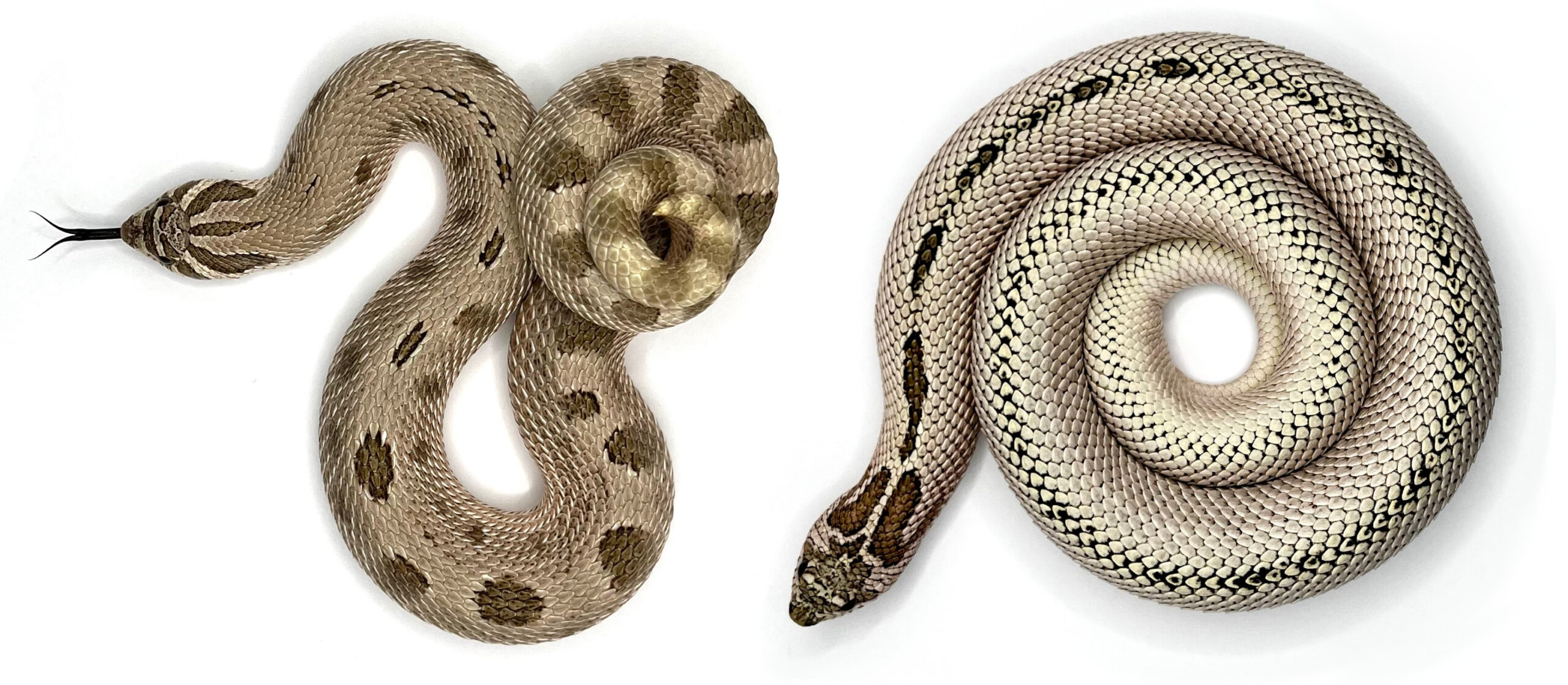
The anaconda morph in western hognose snakes is the clearest example. A snake carrying one copy of the anaconda gene is an anaconda — showing the characteristic reduced patterning. A snake carrying two copies is a superconda — typically showing little to no pattern, often with dramatically different coloration from a single-copy anaconda. Breeding anaconda to anaconda produces a statistical mix of normals, anacondas, and supercondas in predictable ratios.
Het is short for heterozygous — carrying one copy of a recessive gene without visually expressing it.
When breeders list animals as het albino, they mean the snake carries one copy of the albino gene. It looks normal. It breeds normally. But in the right pairing, it will produce visual albino offspring.
You'll also see percentages attached to het designations: 100% het, 66% het, 50% het. These reflect probability rather than certainty, and they arise from pairings where offspring could or could not have inherited a het gene depending on which combination they received.
100% het means the snake definitely carries one copy of the gene — its parentage guarantees it.
66% het means there's a two-in-three chance the snake carries the gene. This comes from pairings where one third of visually normal offspring statistically don't carry the gene, and two thirds do — but since they all look normal, you can't tell which is which without breeding them out.
50% het means there's a one-in-two chance. Same principle, different ratio.
When you breed a 66% het animal and it produces visual offspring, it's confirmed as a het. Until then, the percentage represents uncertainty, not certainty.
A Punnett square is a simple grid that maps out every possible genetic combination two parents can produce. For a single recessive gene like albino, you need a two-by-two grid.
Convention: uppercase letters represent the normal (dominant) version of the gene, lowercase represent the recessive version. For albino: A is normal, a is albino. A visual albino is aa. A het albino is Aa. A normal with no albino gene at all is AA.
Both parents are Aa — they carry one albino gene each but look normal.
| A | a | |
|---|---|---|
| A | AA | Aa |
| a | Aa | aa |
Results:
This is the classic het-to-het pairing. On average, one in four offspring will be visual albino. The three that look normal are a mixture of true normals (AA) and hets (Aa) — without breeding them out or genetic testing, you can't tell which is which from appearance alone. This is where the 66% het designation comes from: of the visually normal offspring from this pairing, statistically two thirds are het and one third are not.
One parent is Aa, the other is aa.
| A | a | |
|---|---|---|
| a | Aa | aa |
| a | Aa | aa |
Results:
This pairing is useful when you want to produce visual albinos more efficiently than het-to-het allows, or when you want to het-up animals for future breeding projects. Every offspring is either a visual albino or a confirmed het — no ambiguity.
One parent is aa, the other is AA — a true normal with no albino gene.
| A | A | |
|---|---|---|
| a | Aa | Aa |
| a | Aa | Aa |
Results:
No visual albinos, but every offspring is a confirmed 100% het. This is how you introduce a new recessive gene into a breeding project — the first generation produces no visuals, but you've guaranteed het status across the entire clutch.
A snow western hognose is the product of two separate recessive genes expressing simultaneously: albino and axanthic. A visual snow is homozygous for both — aa for albino and bb for axanthic (using b to represent axanthic for clarity).
To produce snows, both parents need to carry both genes. The most efficient way to do this is with double het animals — snakes that are het albino and het axanthic simultaneously (AaBb). Breeding double het to double het gives you a statistical chance of producing animals that are homozygous for both recessive genes in the same clutch.
The mathematics get more complex with two independent genes because each gene segregates independently. The probability of an offspring being homozygous for both simultaneously is the probability of being albino (25%) multiplied by the probability of being axanthic (25%) — which gives 6.25%, or roughly one in sixteen offspring. In a typical hognose clutch of twelve to twenty eggs, you might expect one or two snows, though the actual number in any given clutch varies.
This is why experienced breeders talk about breeding toward a morph over multiple generations. If you don't already have double hets, you might breed an albino to an axanthic, producing all offspring that are het for both but visual for neither. Those double hets are then bred together in the next generation to produce snows. The first generation produces no visual snows. The second generation does. Knowing this going in makes the process feel like a plan rather than a disappointment.
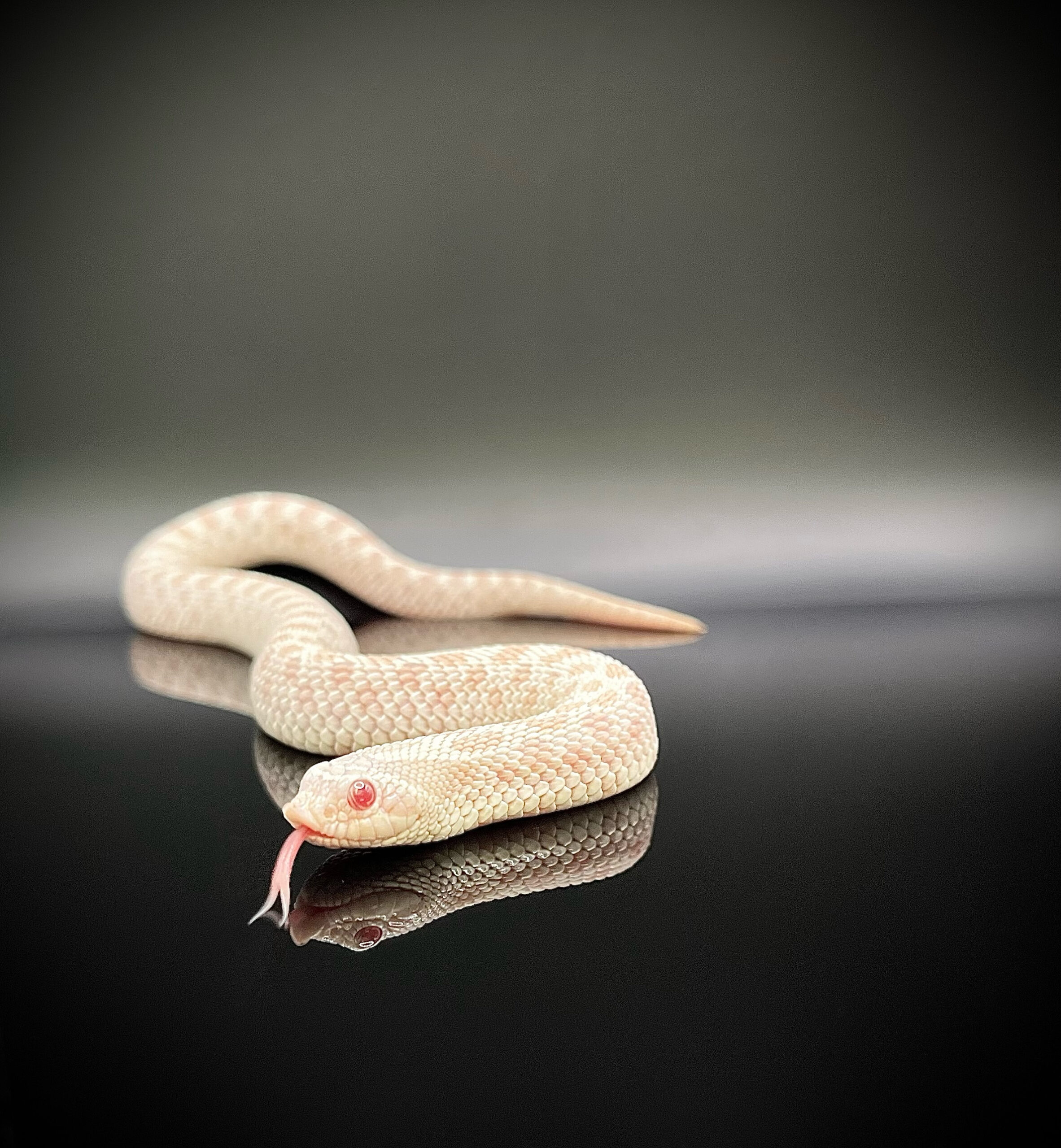
The anaconda morph demonstrates codominant inheritance cleanly. One copy of the anaconda gene produces an anaconda. Two copies produce a superconda — typically showing far more dramatically reduced patterning, often nearly patternless, with distinct coloration differences from a single-copy anaconda.
Breeding anaconda to anaconda (using An for anaconda and + for normal):
| An | + | |
|---|---|---|
| An | AnAn (Superconda) | An+ (Anaconda) |
| + | An+ (Anaconda) | Aa ++ (Normal) |
Results:
The superconda is visually distinct from the anaconda — you can often tell by appearance, which is one of the features that makes codominant genes straightforward to work with compared to recessives.
Albino × Normal (no het): 100% het albino, no visual albinos
Albino × Het Albino: 50% visual albino, 50% het albino
Het Albino × Het Albino: 25% visual albino, 50% het albino, 25% normal
Albino × Albino: 100% visual albino
Anaconda × Normal: 50% anaconda, 50% normal
Anaconda × Anaconda: 25% superconda, 50% anaconda, 25% normal
Double Het Snow × Double Het Snow: 6.25% snow, various het and normal combinations across the rest of the clutch
Keep records from the beginning. The genetic value of an animal is only as reliable as the records behind it. A snake listed as het albino from an unknown pairing is worth considerably less — both financially and in breeding terms — than one whose parentage is documented. Accurate records are the foundation of a credible breeding program.
Understand what you can and can't know from appearance. Visual inspection tells you whether a recessive gene is expressing — it tells you nothing about whether a visually normal animal is het for something. Codominant genes are easier to work with in this respect because carriers are visually distinguishable. Recessive hets are invisible until you breed them out.
Plan multiple generations ahead. If you're working toward a specific combination that requires two or more recessive genes, map out the breeding path before you start. Knowing that your first generation will produce no visuals but will het-up your stock makes the process feel intentional rather than frustrating.
Don't underestimate the value of hets. A 100% double het from a good pairing is often more valuable in breeding terms than a visual single morph, because it's the vehicle for producing more complex combinations in the next generation.
One of the things that draws people to hognose breeding specifically, beyond the animals themselves, is the puzzle element of the genetics. Planning a pairing with a specific outcome in mind, incubating the clutch, and then seeing the morph ratios play out — or occasionally surprise you — is genuinely satisfying in a way that's hard to explain to anyone who hasn't experienced it. The mathematics don't guarantee outcomes in individual clutches. Statistics apply across large numbers, and a clutch of fifteen eggs is a small sample.
You can breed het to het and get no visual albinos, or get five. The probabilities are what they are per individual egg, and each egg is an independent event.
But understanding the genetics means understanding why the possibilities exist — and that understanding is what makes the outcomes, however they land, feel meaningful rather than random.
You must be logged in to post a comment.
No comments yet — be the first.