
If you've read our picky eater guide, you already know that scenting is one of the most effective tools for getting a reluctant hognose to eat. What that guide doesn't cover in detail is the practical side: how to actually prepare fish for scenting, what to buy, how to store it, and what to do when one approach doesn't work.
This post fills that gap. It's the information I wish had existed when I was figuring this out the first time.
Western hognose snakes are naturally amphibian hunters. Frogs and toads are their primary prey in the wild, which means their feeding instincts are calibrated toward that kind of scent profile, not the smell of a mouse. Getting frog or lizard scent onto prey items in captivity isn't impossible, but it's not always practical either. Commercial frog scent products exist, but they're not available everywhere and not every keeper has easy access to them.
Fish is the practical alternative, and it works remarkably well. The strong, distinctive smell of fish is enough to trigger a feeding response in many hognoses that won't touch an unscented pinky, and the scent transfer process is simple enough that anyone can do it at home with minimal preparation.
The fish that have worked consistently for us: tuna, salmon, and hake. All three have a strong enough scent profile to make a real difference, and all three are easy to find in most supermarkets.
Fresh fish is preferable to canned when you can get it. The scent is more intense and there are no additives to worry about. But canned fish works too, which makes this approach accessible even if you can't get to a fishmonger regularly.
A note on canned fish: if you're using canned, check the ingredients carefully. Fish in natural oil (usually sunflower or olive) is the best option. Vegetable oil versions are fine as a fallback — it's not ideal for a snake to eat a small amount of oil, but it's considerably better than the snake not eating at all, and the quantities involved are tiny. What you want to avoid is fish in brine, heavily seasoned products, or anything with added flavourings. Plain fish in oil is what you're looking for.
One important warning with canned fish: bones. Small bones can be present in canned fish even when the product doesn't appear to contain them. If you're offering a piece of fish directly as prey rather than just using it for scenting, go through the piece carefully before offering it. A bone lodged in a small snake's digestive tract is a serious problem. Take the extra thirty seconds to check.
This is the part that nobody explained to me when I started, and it made the whole process much harder than it needed to be.
When you buy fresh fish, don't put the whole piece in a bag and freeze it. You'll end up with one solid frozen block that you can't separate without thawing the whole thing, which defeats the purpose entirely.
Cut the fish into small pieces, roughly pinky sized. This gives you pieces that are the right scale both for scenting and for offering directly as prey.
Lay the pieces out individually on a sheet of baking paper, making sure they're not touching each other.
Freeze them on the baking paper until solid. This usually takes a few hours.
Once frozen solid, transfer the individual pieces into a freezer bag or container. Because they were frozen separately, they won't clump together and you can take out exactly one piece at a time without disturbing the rest.
Storage: don't keep frozen fish pieces indefinitely. I prepare them when I need them and discard whatever is left after six months. Fish that's been in the freezer too long loses scent intensity, which is the whole point of having it. Fresh batches work better.
When feeding day comes, take one piece from the freezer and let it thaw. Because the pieces are small, this doesn't take long. Ten to fifteen minutes at room temperature is usually enough.
Once thawed, pick up your prey item with feeding tongs and brush it gently across the fish piece. You don't need to coat it thoroughly, a light pass is enough to transfer the scent. The snake's Jacobson's organ is sensitive enough to detect very small amounts of chemical information, and you're not trying to disguise the prey item as something else entirely. You're just adding a scent layer that makes it more recognizable as food.
Offer the scented prey item as normal. Leave the snake alone with it if tong feeding doesn't produce a strike. Many picky feeders prefer to eat unobserved.
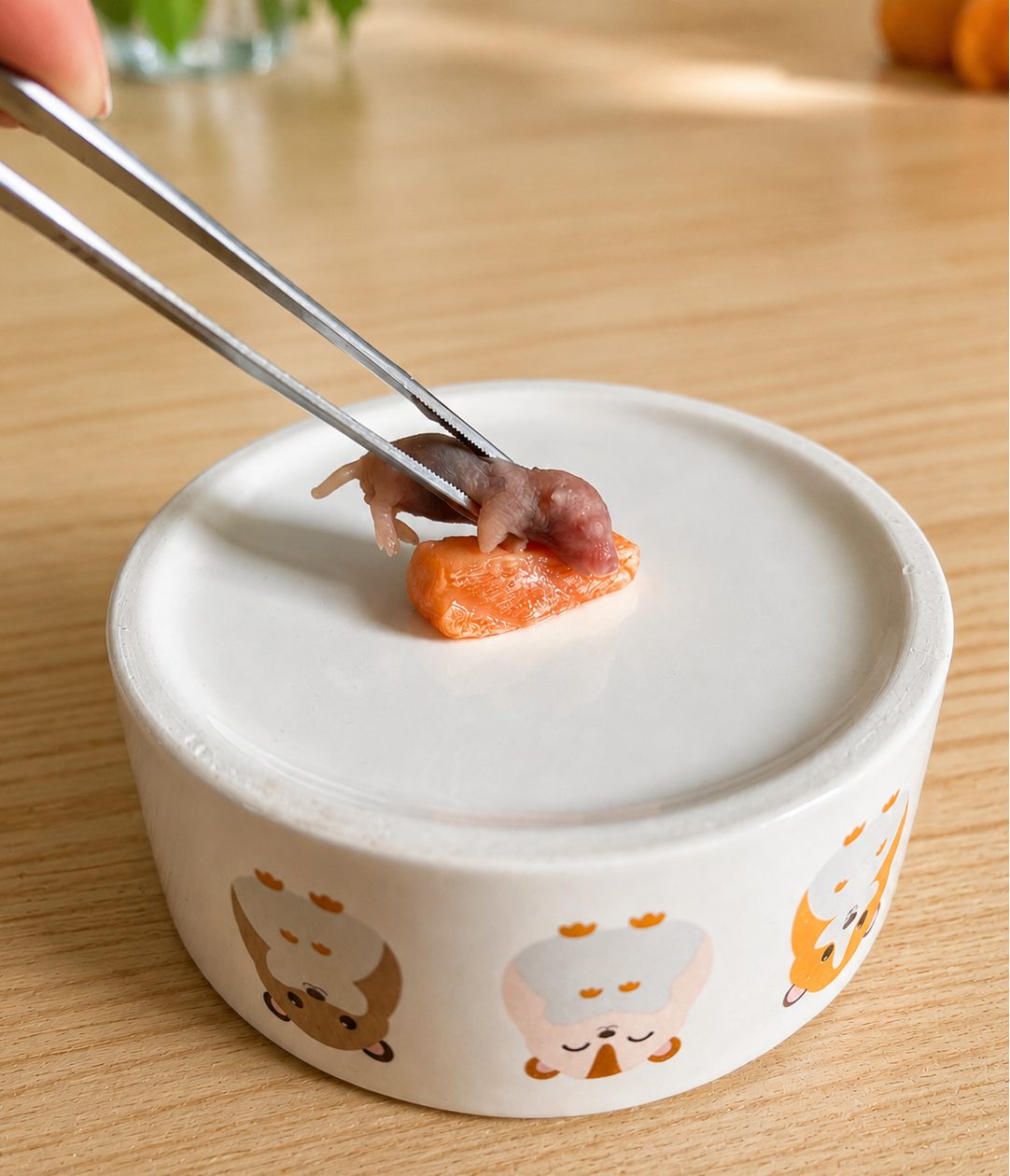
Some snakes, particularly hatchlings or animals that have been refusing for a long time, won't make the connection between a scented pinky and food even with the fish smell present. In these cases, skip the pinky entirely and offer the fish piece itself.
Thaw one piece, offer it with tongs the same way you would a prey item. If the snake doesn't respond to tuna, try salmon next time. If salmon doesn't work, try hake. Different fish have different scent profiles and individual snakes have individual preferences. There's no single fish that works for every animal, which is why having more than one option available matters.
If the snake eats the fish piece, that's a win. Don't immediately switch back to pinkies the next feeding day. Let the snake eat fish pieces for approximately five consecutive meals first. This does two things: it gets calories into an animal that may have been running on empty for weeks, and it establishes a positive feeding association that you can then build on.
After those five meals, offer a pinky scented with the same fish the snake has been eating. In most cases, they'll take it. The combination of hunger, established feeding momentum, and a familiar scent is usually enough to bridge the gap.
Don't panic. Don't offer again the next day. Wait a full week.
A snake that has been eating fish pieces has some caloric reserve now, which means you have time to let hunger do its work. After a week, offer the scented pinky again. The appetite will have built and the threshold for striking is lower than it was.
This process — fish pieces to build momentum, then a transition to scented pinkies — is slower than you'd like when you're in the middle of it. But it works consistently, and a snake that's eating scented pinkies is a snake that's one or two steps away from eating unscented pinkies, which is where you ultimately want to be.
Patience here is genuinely productive rather than just waiting. Every meal, even a fish piece, is progress.
Buy: fresh tuna, salmon, or hake — or canned versions in natural or vegetable oil (not brine, not seasoned).
Prepare fresh fish: cut to pinky size, freeze individually on baking paper, transfer to a bag once solid.
Store: use within six months, prepare fresh batches as needed.
For scenting: thaw one piece, brush the prey item across it lightly with tongs, offer as normal.
For direct feeding: thaw one piece, offer with tongs as prey. Check carefully for bones in canned fish.
The transition: let the snake eat fish pieces for about five meals, then offer a pinky scented with the same fish. Wait a full week between attempts if the pinky is refused.

No comments yet — be the first.