
If you've read our post about first feeding day from the 2024 clutch, you might remember the smallest hatchling, the one we were quietly most concerned about. Turns out, we had nothing to worry about, she struck without hesitation on her very first feeding.
At the time, that moment felt like a good story with a clean ending. Small snake, big personality, moved on to a new home.
It turned out to be the beginning of something longer.
Once hatchlings are feeding consistently, the focus shifts gradually from survival to development. It's no longer just about getting food into them, it's about tracking growth, monitoring consistency, and eventually thinking about where each animal is going to go.
We sell our western hognose snakes locally wherever possible, and that's a deliberate choice. It means we can stay in contact with the people who take them. We don't hand over a snake and consider the relationship finished — we stay available, answer questions, and genuinely enjoy hearing how things are going.
The messages that come in from new owners are honestly one of the best parts of breeding. Photos of freshly set-up enclosures. Updates about names chosen. "We named him Karlito." "Meet Princess Ruby." "Here's Flame exploring his new hide." Watching animals we hatched and raised become part of someone else's home and someone else's routine — that never gets old, no matter how many clutches we've been through.
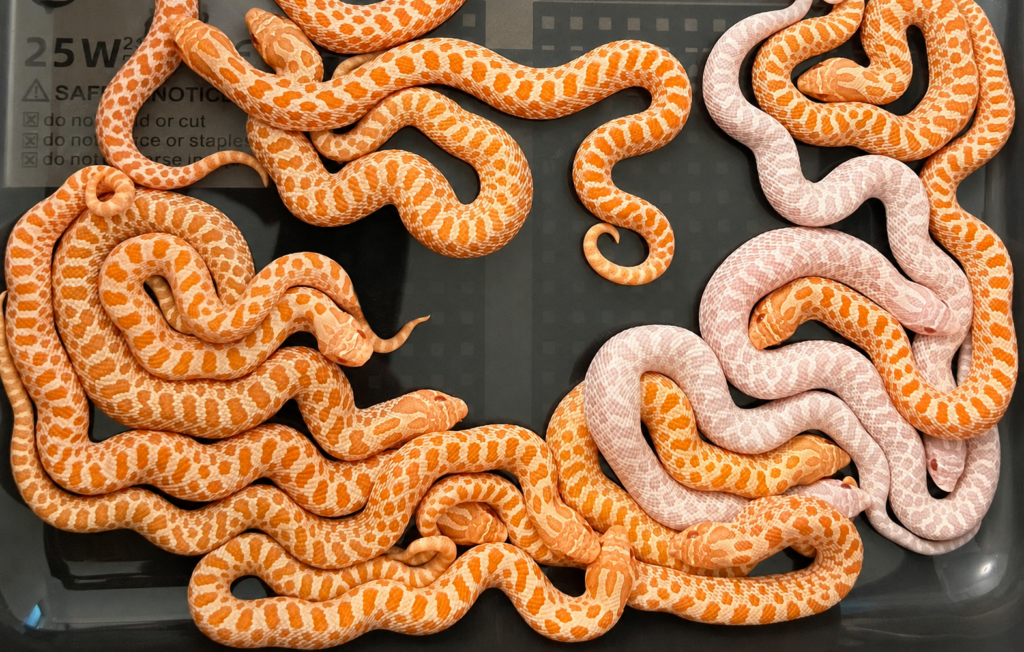
Before any snake leaves us, there's one standard that isn't negotiable: reliable, consistent feeding.
We track every meal across the entire clutch. What they ate, when they ate it, how they responded to the offer, and — just as importantly — when they didn't eat. A missed meal resets the count. Our threshold before a snake is considered ready to go to a new home is ten consecutive meals without refusal.
Ten in a row. If a snake eats five times and skips one, we start again from zero.
It sounds strict, and it is. But the reason is simple: the single most consistent piece of feedback we get from people who take our snakes is that they're surprised by how well they eat. That's not luck. That's the result of not cutting the process short.
A snake that has eaten ten consecutive meals in a controlled, familiar environment has demonstrated something real about its feeding stability. A snake that has eaten five or six times hasn't. The difference matters when that animal moves to a new home, new enclosure, new smells, new hands — all the variables that can disrupt a feeding response in an animal that wasn't fully established to begin with.
The tiny female from first feeding day ate from the beginning and never really stopped. No hesitation, no tricks required, no missed meals that forced a count reset. She grew steadily, developed well, and when the time came, we found her a home we felt good about.
We got the usual update shortly after she arrived: a photo of her new enclosure, everything set up properly, and her new name.
Pinky.
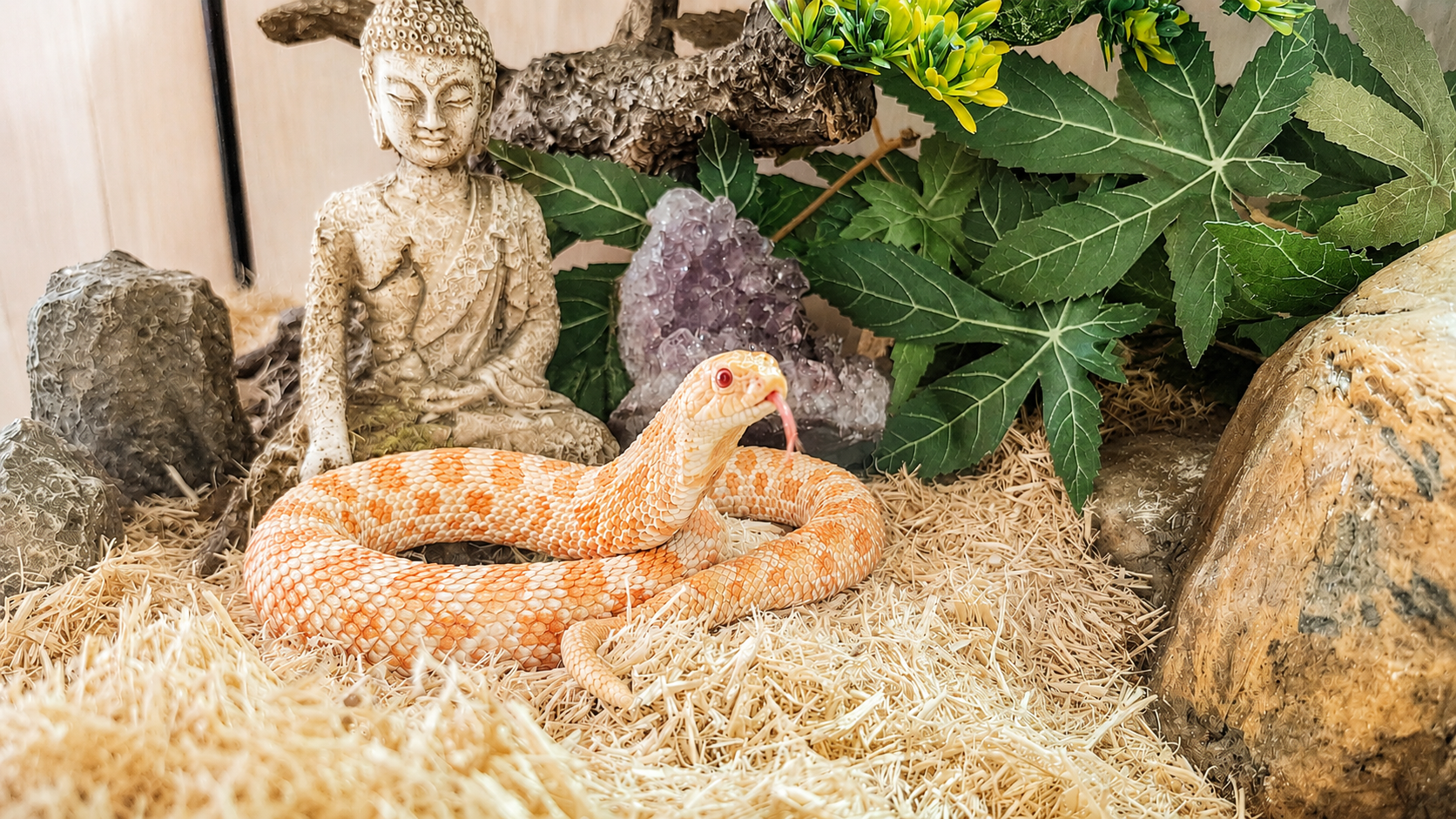
Everything looked right. We moved on, keeping an occasional eye on updates as they came in.
And then, a few months later, a message arrived.
Pinky had not eaten yet.
A feeding refusal after rehoming isn't immediately alarming. Snakes are sensitive to environmental change, and a new home (new enclosure, new substrate, new smells, different handling) can disrupt feeding in an animal that was previously reliable. We've seen it before. It usually resolves within a few weeks once the animal settles.
We went through everything with her new family: enclosure dimensions, temperature gradient, substrate type, hide placement, feeding method and presentation. Everything they described was correct. Nothing stood out as an obvious cause.
Pinky was showing interest. She'd come to the food, tongue-flick, investigate — and then turn away. The curiosity was there. The follow through wasn't.
They tried scenting the prey, adjusting the presentation, varying the timing. Different approaches, same result.
Two months in, with no progress and Pinky's weight beginning to fall noticeably behind where it should have been for her age, we made the decision to bring her back.
The timing, in retrospect, was something.
Pinky came back to us about a week after Julija died. If you've read that post, you know what that period was like. Losing an animal you've cared for over years leaves a specific kind of heaviness that doesn't lift quickly. The reptile room felt quieter than it should.
And then Pinky arrived.
I don't want to overstate it. She was a snake with a feeding problem, not a therapeutic intervention. But there's something about having a small animal to focus on — a concrete problem with a potential solution, a tub to check, a feeding day to prepare for — that gives you somewhere to put your attention when your attention has nowhere good to go. It helped. That's all I'll say about it.
We kept Pinky's setup simple: a temporary enclosure, a couple of hides, heat, water. Nothing she hadn't seen before in some form. We gave her three days to settle without any interference before attempting a feed — long enough to decompress from the travel, not so long that we were losing ground unnecessarily.
Compared to her siblings who were still with us and eating on schedule, you could see she'd fallen behind. Not dramatically, not in a way that raised serious health concerns, but noticeably. The gap that opens up when a growing snake misses two months of regular feeding is visible when you put it next to animals the same age that haven't.
Feeding day came.
I prepared a normal sized fuzzy (the same prey size she'd been eating before she left) opened the tub, and offered it. She came out immediately, oriented toward the prey, and struck. Clean, fast, and completely confident, like she'd been doing it every week without interruption.
What the hell, Pinky!
Two months of refusals at her new home, and she ate within seconds of being offered food back here. No transition period, no hesitation, no coaxing required. Just a snake who had apparently decided she was ready to eat again, on her own schedule and nobody else's.
We kept Pinky for about a month, feeding her every four to five days to help her recover the weight she'd lost. She didn't miss a single meal across that entire period. Not one refusal, not one moment of hesitation. Just consistent, reliable feeding, exactly what she'd been before she left.
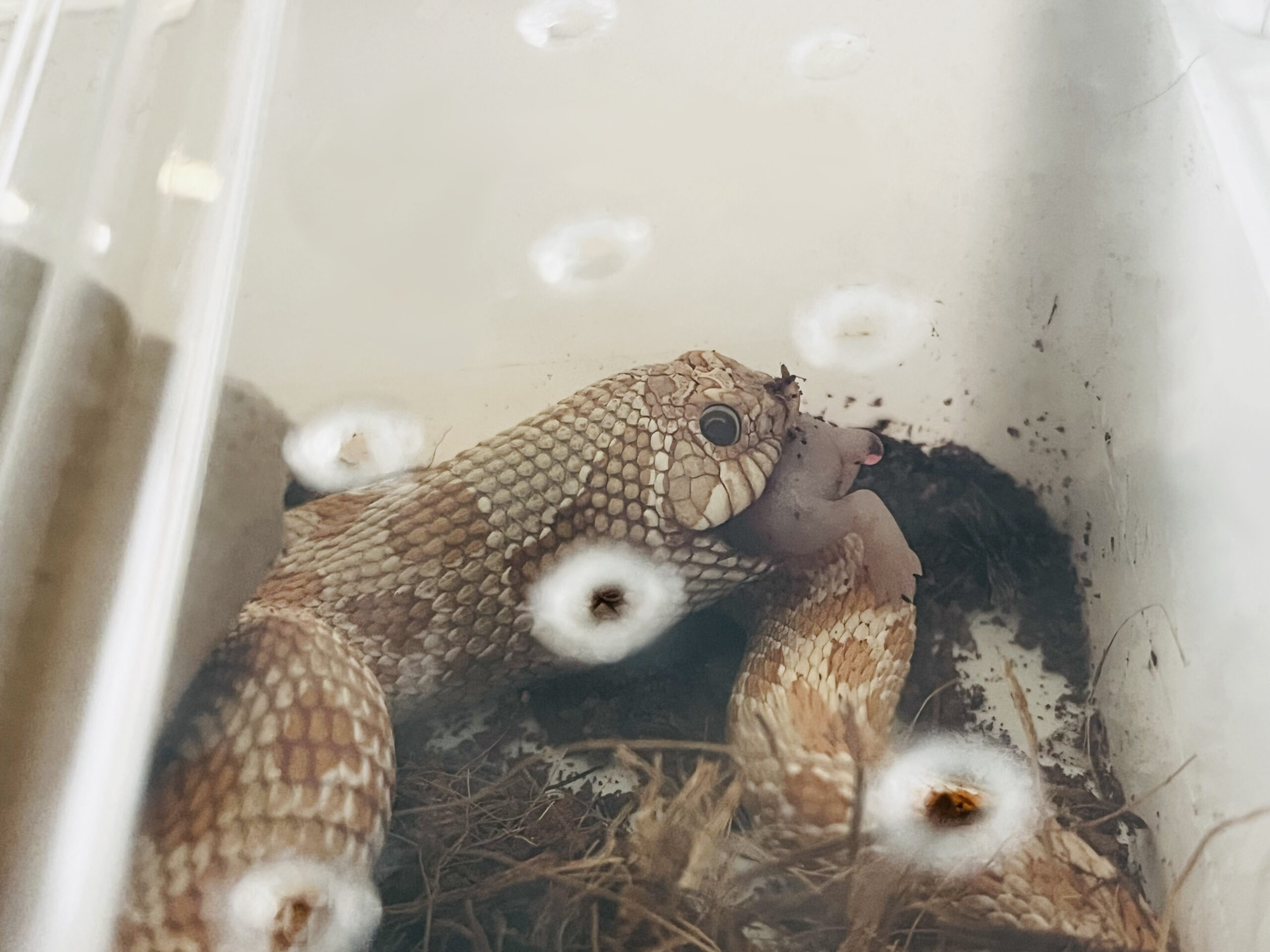
By the end of the month, the gap between her and her siblings had closed to something much less noticeable. She was back to where she should have been.
Then she went home.
And this time, she kept eating.
The easy conclusion is that something was wrong with her setup at her new home, and bringing her back fixed it. But that's not quite right. We went through her setup carefully with her family and nothing was incorrect. Temperatures were where they needed to be. The enclosure was appropriately sized. The feeding approach was sound.
Sometimes the answer is just that snakes are individual animals with individual responses to stress, change, and environment, and those responses don't always follow a clear logic. Pinky didn't refuse food because something was wrong. She refused because something was different, and different was enough. Coming back to a familiar environment, familiar smells, familiar handling — whatever the specific trigger was, something reset.
That's not a flaw in the new home. It's not a failure in how she was raised. It's just how some animals respond to change, and it's a reminder that the work doesn't end when a snake leaves your care.
This is why we don't rush sales, why we track feeding so carefully before letting animals go, and why we make it clear to every new owner that we're available. Not as a formality, but because we mean it. And if a snake needs to come back for a reset, it comes back. No hesitation, no conditions.
I've thought about the timing more than once since January. A week after losing Julija, Pinky arrived with a solvable problem and ate within seconds of her first offer back home. That small, immediate win — after weeks of outcomes that couldn't be changed — mattered more than it probably should have.
Maybe it was coincidence. Maybe it was just good timing in the way that sometimes things are.
Either way, I'm glad she came back when she did.
You must be logged in to post a comment.

No comments yet — be the first.