
If you haven't read Part 1, Hopper is one of our 2025 hognose hatchlings who refused every feeding attempt for three months before finally taking her first meal on October 13th — a piece of hake from a forgotten can at the back of the fridge. Part 2 picks up from there.
After the hake breakthrough, Hopper ate four more times over the following weeks. Five meals total since hatch. Not much by any measure, but each one mattered more than the number suggests. Because hake is calorie dense, even small portions were doing real work. Her body was slowly recovering. The thinness that had been so visible at the two month mark was beginning to ease, and her movement had some of its early energy back.
For the first time since July, things felt like they were quietly settling into something manageable.
And then December 11th happened.
I opened Hopper's tub to clean it — routine, same as any other day — and she looked at me strangely. Her head was tilted at an angle that just didn't look right. Not the exaggerated defensive posturing that hognose snakes are famous for, not the playing dead routine.
Something different. Something that made me stop.
While I was finishing the cleaning, she started moving in a way I hadn't seen before. The front part of her body lifted and twisted backward. She was opening her mouth repeatedly, not in a strike or a threat display, but in the slow, deliberate way of an animal that is working to breathe.
That's the moment the word "respiratory" entered my head, and once it did, I couldn't think of anything else.
A respiratory infection in snakes — RI for short — is an infection of the airways and lungs, most commonly bacterial in origin. In reptile keeping, it's one of the more serious conditions you're likely to encounter, and it's almost always linked to husbandry conditions: temperatures that are too low, humidity that's too high, or a combination of both that gradually compromises the immune system until opportunistic bacteria take hold.
The early signs are easy to miss if you're not looking for them. Mouth breathing. A subtle clicking or wheezing sound when the snake inhales. The head held at an unusual angle, which happens because the snake is trying to clear fluid from the airways by repositioning. Excess lethargy, loss of appetite, a general quality of being "off" that's hard to describe precisely but obvious once you know what you're seeing. In advanced cases there may be discharge from the mouth or nose, or visible bubbling when the snake breathes.
Hopper had the mouth opening, the head tilt, and the body twisting. I listened closely to her breathing.
Clicking. Faint, but there.
I already knew what I was dealing with.
When a respiratory infection is suspected, the response needs to be the same day. Not "let's monitor for a few more days," not "maybe it'll resolve on its own." RI in snakes does not resolve on its own. It progresses.
Hopper was moved immediately into a clean, minimal setup: a small tub, paper towel substrate, one hide, and a consistent warm spot maintained around the clock. No water dish inside the enclosure.
That last point surprises people, but it's important. Humidity is a significant driver of respiratory infections in snakes, and an open water dish contributes meaningfully to ambient humidity in an enclosed tub. Removing it doesn't mean withholding hydration, it means controlling the environment more tightly. Every day, I took Hopper out and offered water manually. She drank consistently and well. After drinking, the clicking occasionally worsened slightly, which sounds alarming but likely reflects the water moving through the system and temporarily affecting how clearly the airways sounded. She was hydrated. That was what mattered.
I also made the decision to monitor closely rather than go to the vet immediately. This isn't a recommendation for every situation. There are cases where RI requires antibiotics and veterinary intervention without delay, and any keeper who is uncertain should see a vet. In Hopper's case, I caught it early, the symptoms were not advanced, and I wanted to give careful husbandry management a short window to show whether it was sufficient. I set a clear threshold for myself: any deterioration, any sign the infection was worsening rather than holding steady, and we'd be at the vet the next morning.
Her behavior became a mix of good days and bad days. But one thing was consistent. She stopped eating again.
Around December 19th (eight days into the RI) Hopper went into shed.
In an otherwise healthy snake, a shed is unremarkable. You increase humidity slightly, you give the animal space, and ten days later the skin comes off cleanly. But Hopper wasn't an otherwise healthy snake, and increasing humidity was exactly what her respiratory infection didn't need. I made the decision to leave the setup unchanged. Her health came before the shed.
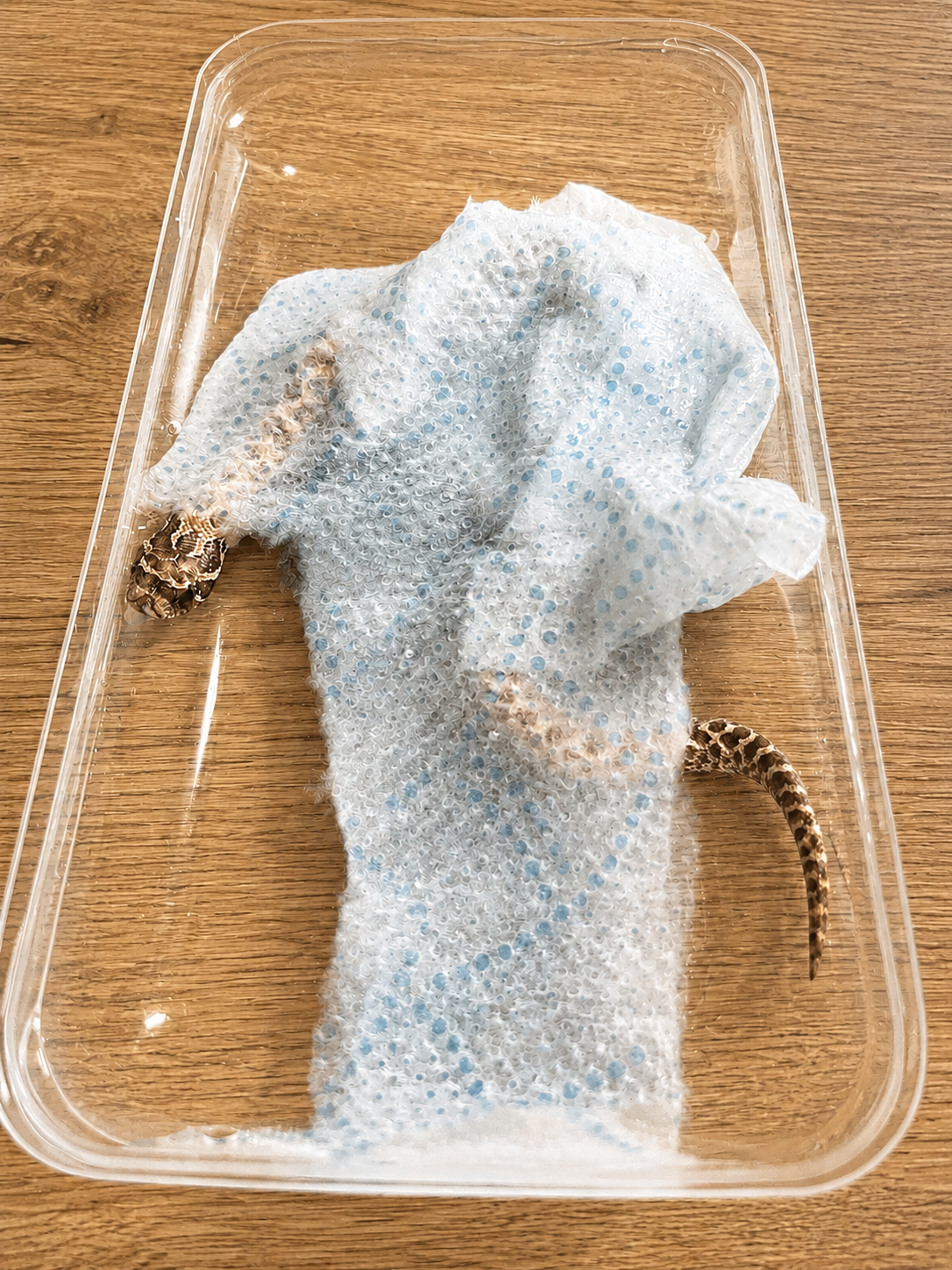
The consequence was predictable but still difficult to watch: the shed stalled. Days passed. Then weeks. The skin that should have come off in a normal cycle looked dry and tight against her body, almost wrinkled, lacking the soft separation from the underlying scales that a shed in progress should have. Four weeks in, it was clear she wasn't going to manage it alone.
I had been giving her daily warm soaks throughout, both for hydration and to try to soften the skin gently. They helped keep things from getting worse but weren't enough to get the shed moving. Eventually, careful manual assistance was the only remaining option, and once we started, it came away more easily than expected, as though her body had simply been waiting for that initial release point.
The shed was off. One problem down.
What nobody tells you about nursing a snake through a respiratory infection is how nonlinear the recovery feels. There is no steady upward trajectory. There are good days — days where Hopper moved with something close to her normal energy, where the clicking was barely audible, where she seemed almost fine — followed by bad days where she was clearly struggling again, head tilted, breathing audibly, still and quiet in her hide.
The inconsistency is harder to manage psychologically than a consistent deterioration would be, in some ways. With deterioration, you know what you're dealing with. The good-day-bad-day pattern keeps you in a state of uncertainty that's genuinely exhausting, because you can't tell whether the good days represent real progress or whether the bad days are the actual trajectory.
I kept the setup stable, kept offering water daily, kept the warm spot consistent, and waited.
The day after the stuck shed was finally resolved, I offered food. Not with any real expectation, mostly out of habit.
She took it.
That meal, after weeks of the RI and no eating, was the moment things genuinely began to turn. From that feed onward, she didn't miss another. Each week she ate, and each week the bad days became a little less bad. The clicking faded gradually — present one day, almost gone the next, then quieter still. The mouth opening stopped entirely. Her posture normalized. The head tilt disappeared.
By the first week of February, Hopper looked completely normal. Moving well, eating well, holding weight, behaving like any other hognose hatchling in the rack — curious, alert, slightly dramatic when the tub was opened.
Like nothing had ever happened.
At some point during the worst of it — I don't remember exactly when, somewhere in the middle of the bad days when recovery still felt genuinely uncertain — I made her a quiet, slightly ridiculous promise.
If she got better, she wasn't going anywhere. No rehoming, no "maybe she'll do better with someone else." She would stay.
Hopper earned that. Three months of feeding refusals, five hard won meals, a respiratory infection, a stuck shed, and a recovery that took the better part of two months. All of it in the first six months of her life.
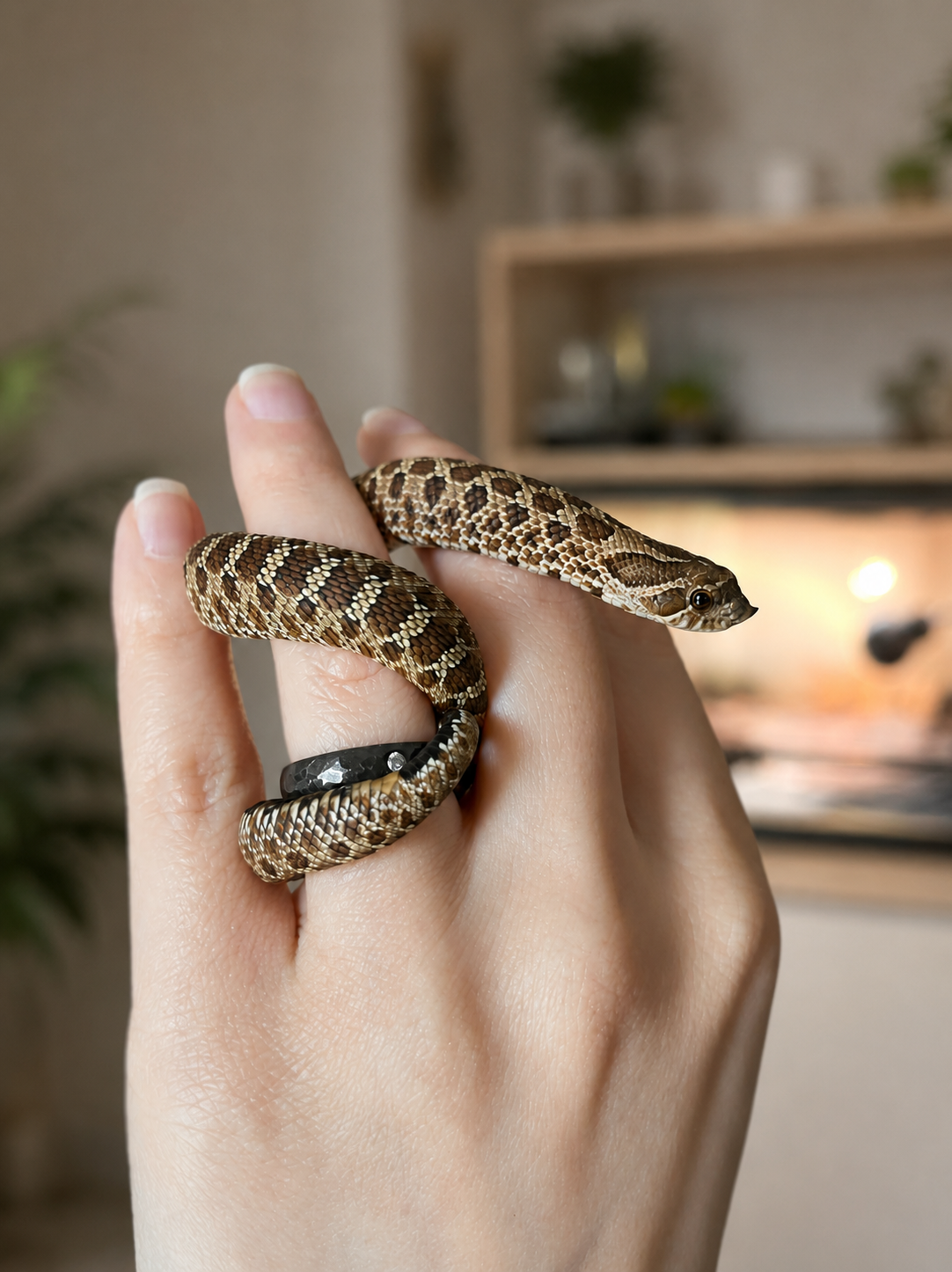
And well… Hopper stayed :)
A few things worth passing on for anyone who finds themselves in a similar situation:
On prolonged feeding refusals: exhaust your options, but think laterally. The standard toolkit exists because it works for most animals, but some hatchlings need something outside the standard toolkit. Different prey species, different scenting agents, different prey presentation. Don't give up before you've tried things you wouldn't normally consider.
On respiratory infections: early detection is everything. Learn the signs (mouth breathing, clicking, unusual head position, lethargy) and respond the same day you see them. A clean, warm, dry environment is the foundation of management. When in doubt, see a vet. Antibiotics are sometimes necessary, and there's no virtue in waiting too long.
On concurrent complications: when a sick animal goes into shed, you'll face tradeoffs with no clean answer. Prioritize the more serious condition. A difficult shed can be assisted manually; a worsening respiratory infection cannot be fixed retroactively.
And on the question of when to give up: that's something every keeper has to answer for themselves, and honestly, there's no shame in any answer. But if you're going to try — really try — then try all the way.
Hopper is glad we did.

No comments yet — be the first.