
Some days in the reptile room are routine. Feed, spot clean, check temps, move on. And then there are days like April 21, 2024 — the day Bajsa went into her pre lay shed, and everything shifted into a different gear.
If you've been following Bajsa's story since the mating post, you already know what the pre lay shed means. For anyone jumping in now: it's a full body shed that typically happens four to ten days before a gravid female deposits her eggs. It's one of the most reliable signals in snake breeding, and when we saw it, we knew the next few weeks were going to demand close attention.
About a week after the pre lay shed, Bajsa began spending serious time investigating her lay box and not long after that, she started going inside.
For those unfamiliar with the concept: a lay box is exactly what it sounds like. It's a secure, enclosed space placed inside the enclosure that gives the female a private, humid environment to deposit her eggs. Without one, females sometimes lay in the water bowl, in a corner of the enclosure, or against the glass — none of which are ideal situations for egg survival.
Ours is set up with moist sphagnum moss and bio ground substrate, which together hold humidity well without becoming waterlogged. We cut an entrance hole just large enough for Bajsa to move in and out comfortably, and we monitor conditions using a thermometer and hygrometer placed on top of the box. The goal is to keep the interior slightly warmer and more humid than the rest of the enclosure — a micro environment that mimics what a female would naturally seek out in the wild when looking for a nest site.
(If you want the full breakdown of how we build and set ours up, we have a dedicated post on Creating the Perfect Lay Box for Western Hognose Snakes.)
Over the days that followed, Bajsa's behavior made it obvious that things were progressing. Her belly had become noticeably rounder and heavier looking. She moved more slowly and deliberately than usual, and she started spending extended stretches either inside the lay box or positioned right next to it. The checking-in-every-few-hours phase had officially begun.
On the night of May 5th — roughly two weeks after the pre lay shed — Bajsa laid her clutch. We woke up to find her mid-process, which is both exciting and slightly nerve wracking when you first see it. Egg laying in snakes can take several hours, and it's important not to disturb a female while she's still depositing. We monitored from a distance and let her finish completely before doing anything else.
By the time she was done, she had laid 20 eggs.
Of those 20, 19 were fertile — firm, smooth, and that characteristic pearly white color that tells you immediately something good is developing inside. The twentieth was a slug: an infertile, unfertilized egg. Slugs are smaller, softer, and often yellowish compared to fertile eggs, and they're a completely normal part of clutches — particularly with younger females or in earlier breeding seasons. Finding one in a clutch of 20 is honestly a good result.
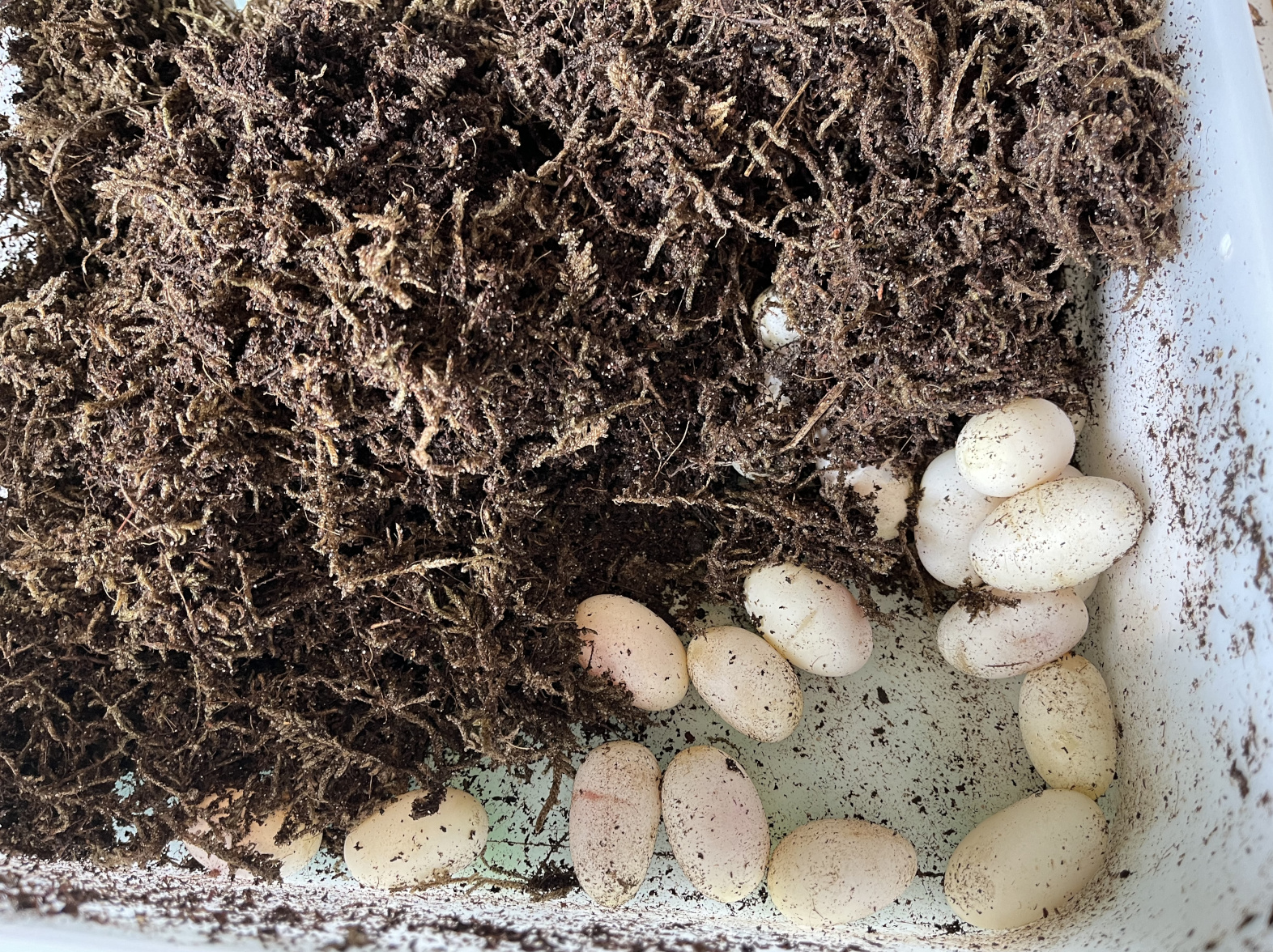
It's worth mentioning what's actually inside a fertile egg at this stage. By the time eggs are laid, the embryo has already been developing for several weeks. Hognose snakes begin embryonic development during the gravid period, before the eggs are even deposited. This is why egg laying snakes like hognoses need proper incubation conditions immediately after laying, not days later. The embryo doesn't pause and wait.
Once Bajsa had finished, she moved away from the lay box on her own and settled onto her basking spot. After the physical effort of producing and laying a clutch that size, she needed rest and warmth — both completely expected. We left her alone and turned our attention to the eggs.
The first step after egg laying is transfer, and it needs to be done carefully. Snake eggs need to be kept in the same orientation they were laid. Flipping them after the embryo has settled can be fatal to the developing snake inside.
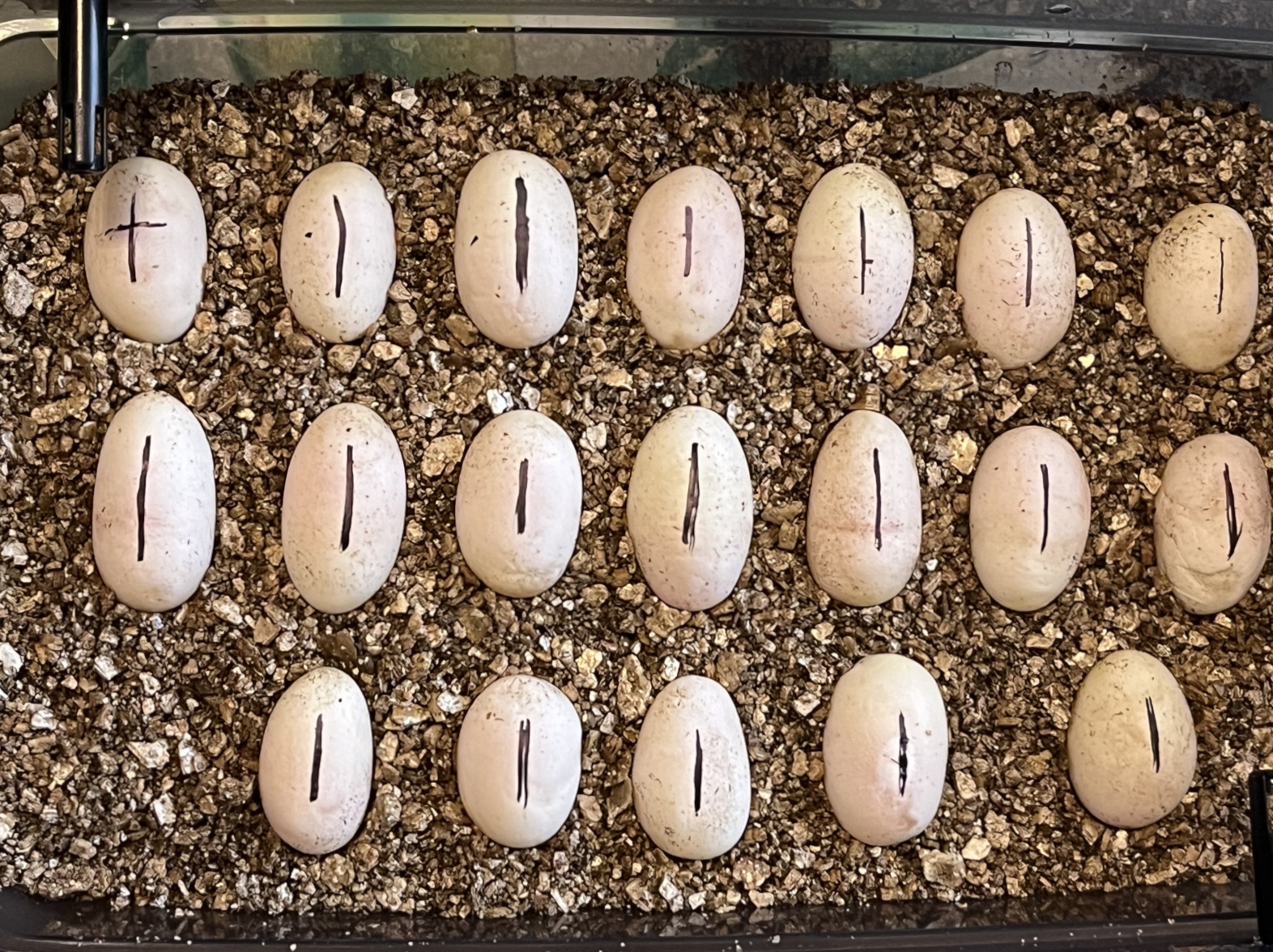
To identify the correct "up" side of each egg, we used a technique called candling — holding a bright, narrow light source against the shell in a darkened room. Through the egg, you can see the embryo and the network of blood vessels surrounding it. This tells you exactly where the embryo is positioned, which side is up, and gives you a general read on how healthy the development looks. We marked the top of each egg lightly with a pencil before moving it, so there was no guesswork later.
The eggs were then transferred to a container filled with slightly moist vermiculite, which is the most commonly used incubation substrate in reptile keeping for good reason. Vermiculite is an expanded mineral that holds humidity without compacting around the eggs or promoting the kind of bacterial growth that wetter substrates can. The goal is to maintain consistent humidity around the eggs throughout incubation without them sitting in anything wet. Eggs that stay too moist for too long can develop mold, while eggs that dry out can desiccate and collapse.
We set the eggs partially buried, not fully covered, and placed the container into the incubator pre-set to 27.7°C (82°F). This temperature sits comfortably in the middle of the recommended range for western hognose incubation. Going warmer tends to produce faster hatching but can increase the risk of developmental issues; cooler temperatures slow things down but can also cause problems if maintained too long.
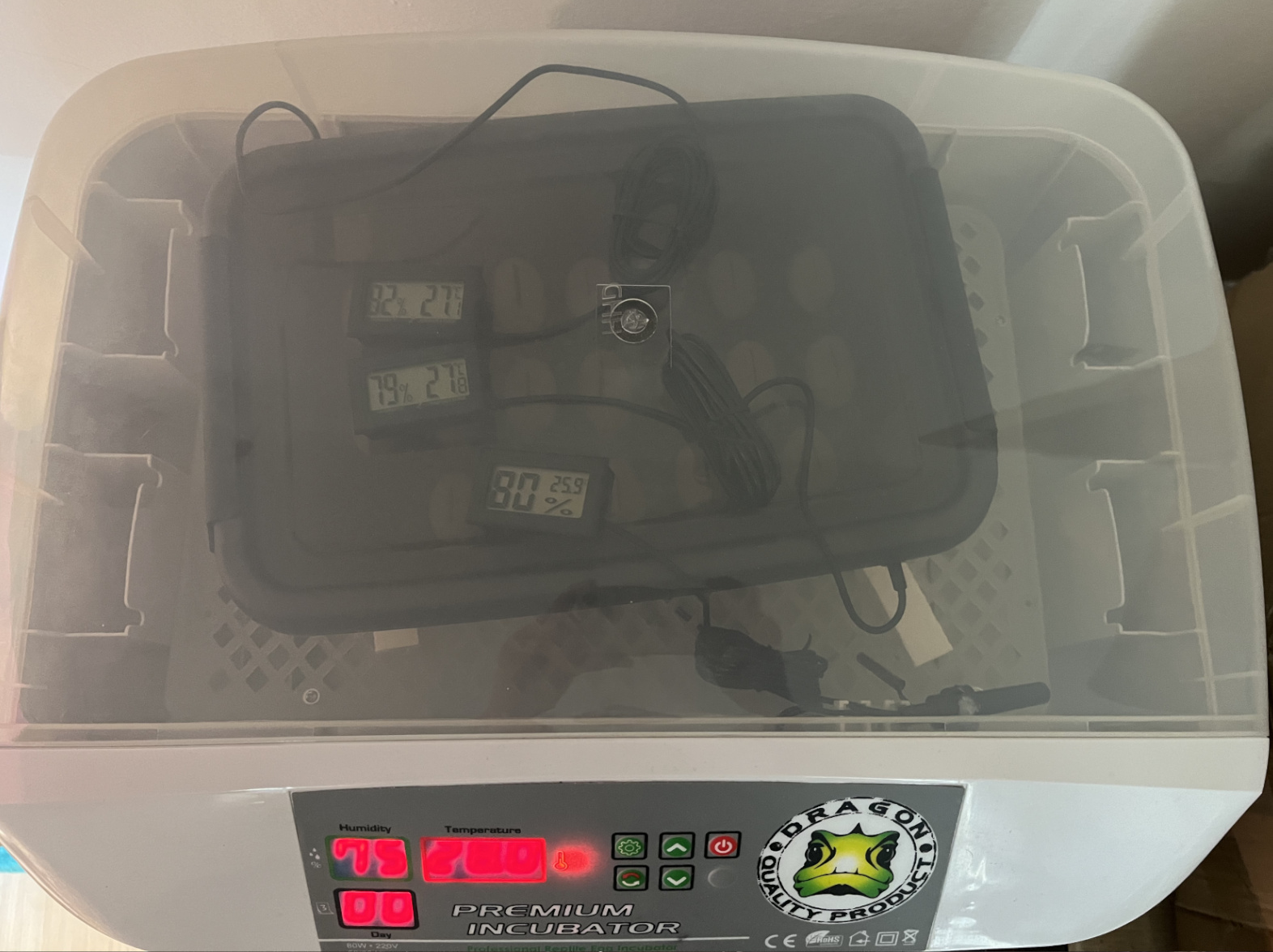
If everything develops as expected, we're looking at 55 to 60 days before hatch day. Which means a lot of monitoring, a lot of waiting, and a lot of resisting the urge to open the incubator more than necessary.
Incubation isn't entirely passive. Over the coming weeks, we'll be checking in regularly to make sure the substrate hasn't dried out, that no eggs have developed visible mold, and that temperatures are holding steady. A small amount of condensation inside the lid of the container is normal and actually a good sign. It means humidity is staying where it should be.
Healthy eggs tend to stay firm and may increase slightly in size as the embryo grows and absorbs moisture from the substrate. An egg that begins to dimple, yellow, or deflate significantly is a warning sign, though not always a death sentence. Sometimes eggs recover, and sometimes what looks bad from the outside is still developing fine within.
Closer to hatch day, we'll candle the eggs again to check on progress, and we'll begin watching for pipping — the moment a hatchling uses its egg tooth to cut through the shell. It's the first sign that the long wait is almost over.
Watching Bajsa go through this entire process — from the first twitch during mating, through the gravid period, to laying a clutch of 20 — has been genuinely one of the better parts of this breeding season. She handled all of it calmly and without complications, which you never fully take for granted until it's over. Now the waiting starts. We'll be posting updates as incubation progresses, and when hatch day finally arrives, you'll be among the first to know.
If you've incubated hognose eggs before — or any reptile eggs — we'd love to hear about your experience in the comments. Every clutch has its own story, and we're only partway through this one.
And as always - stay happy, stay curious, and give your hoggie a gentle boop from me.
You must be logged in to post a comment.

No comments yet — be the first.