
If you've read the Meet the Snakes page, you already know that Nimbus hatched during a storm and that the name wasn't planned. What you don't know is how close she came to never hatching at all — and what the days before she did actually looked like.
This is that story.
The 2023 breeding season was our first time pairing Bajsa and Albi together, and by any measure it went well. Bajsa laid 17 eggs and one slug — a strong first clutch from a first time layer. We were using a Lucky Reptile HatchBox that season rather than placing eggs directly on vermiculite, and the setup seemed solid going into incubation.
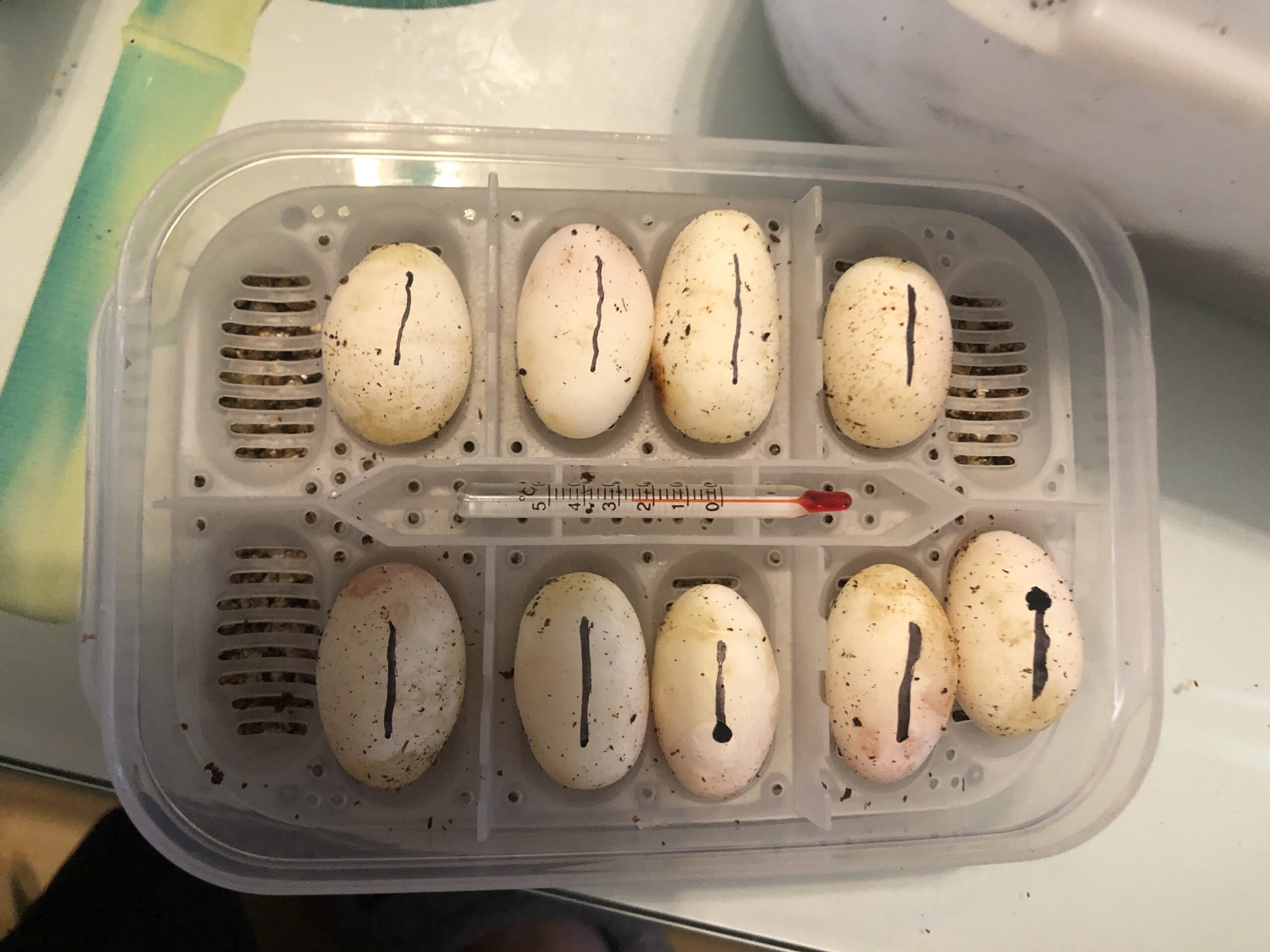
Over the following weeks we lost several eggs. Not unusual, but each one stings regardless of how many seasons you've been through. By the time we were approaching hatch day, eight viable eggs remained in the incubator.
Eight eggs, ten days to go.
And then Slovenia flooded.
What happened in the summer of 2023 was not a normal summer storm. It was one of the worst flooding events the country had seen in decades. Rivers broke their banks across entire regions. Roads were cut off by fallen trees. Houses were destroyed. The images coming in from around the country were genuinely difficult to look at.
And along with everything else, the power went out.
Under normal circumstances, a power cut is an inconvenience. With eight hognose eggs ten days from hatch sitting in an electrically powered incubator, it was something considerably more pressing.
We had a UPS (an uninterruptible power supply) and we got it connected to the incubator immediately. It bought us a few hours of stable power while we figured out what came next. But a UPS isn't a long term solution, and we knew it. The question was what to do when it ran out.
Generators were the obvious answer. We started searching online, in shops, everywhere we could think of. Every single one was sold out. Of course they were. The entire country was dealing with the same problem at the same time, and everyone who needed power was looking for the same solution simultaneously.
So we started calling around — friends, acquaintances, anyone who might have one sitting in a garage somewhere. Eventually, one friend came through. She had a generator and was willing to lend it to us for a few days.
We got in the car and drove to pick it up. The flooding damage we passed on the way was one of those things that recalibrates your sense of scale. Roads undermined, fields turned to lakes, the kind of destruction that takes years to fully repair. People had lost homes, not eggs. We were aware of that the entire time.
We picked up the generator, thanked our friend more than was probably adequate, and drove back with it, grateful that our problem was still one that could be solved with a borrowed machine and a full tank of fuel.
The generator went on immediately. The incubator came back to full power. For the moment, everything was stable.
We thought the power would be back within a day or two. It wasn't.
The generator ran during the day, keeping the incubator at temperature and topping up the UPS so it could carry through the night. But generators are loud and running one through the night wasn't an option. So each evening we shut it down, piled two large blankets over the incubator to hold the heat for as long as possible, and hoped.
Then in the morning, the generator went back on.
We did this for four days.
Four days of checking the incubator temperature every time we uncovered it, holding our breath waiting to see how far it had dropped overnight, and calculating whether the eggs could still be viable after another night of gradual cooling. Four days of filling up fuel and running extension cables and explaining to anyone who asked why there was a generator running in the garden.
The eggs were approaching hatch day through all of it. Whether they were still developing normally inside those shells we genuinely didn't know. All we could do was keep the conditions as stable as we could and wait.
The electricity was eventually restored. The generator went back to our friend. The blankets went back to wherever blankets live when they're not being used as emergency incubation insulation.
And six days after the power came back, the first hatchling emerged. It looked good. Alert, tongue flickering, moving with the purposeful energy of a healthy newborn hognose.
Over the following day and a half, the remaining seven eggs followed. All eight hatchlings out, all of them healthy, all of them having apparently come through four days of generator runs and overnight temperature drops without any of it showing in how they emerged.
Six albinos. And two snows.
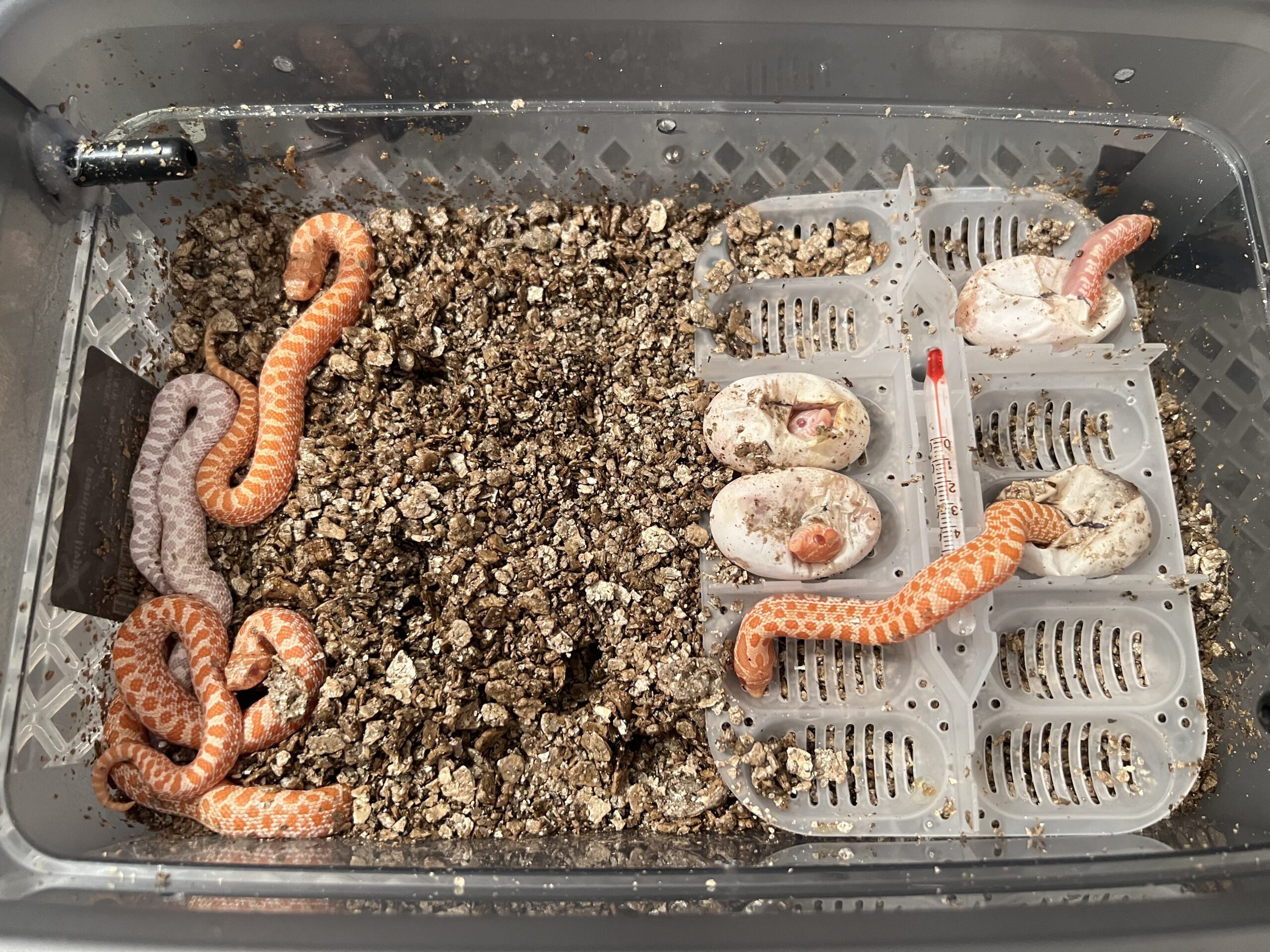
Bajsa is albino het axanthic. Albi is albino het axanthic. The genetic math had always said there was a chance of snows in the clutch. We'd known going into the pairing that snows were possible. Seeing them actually emerge was something else entirely.
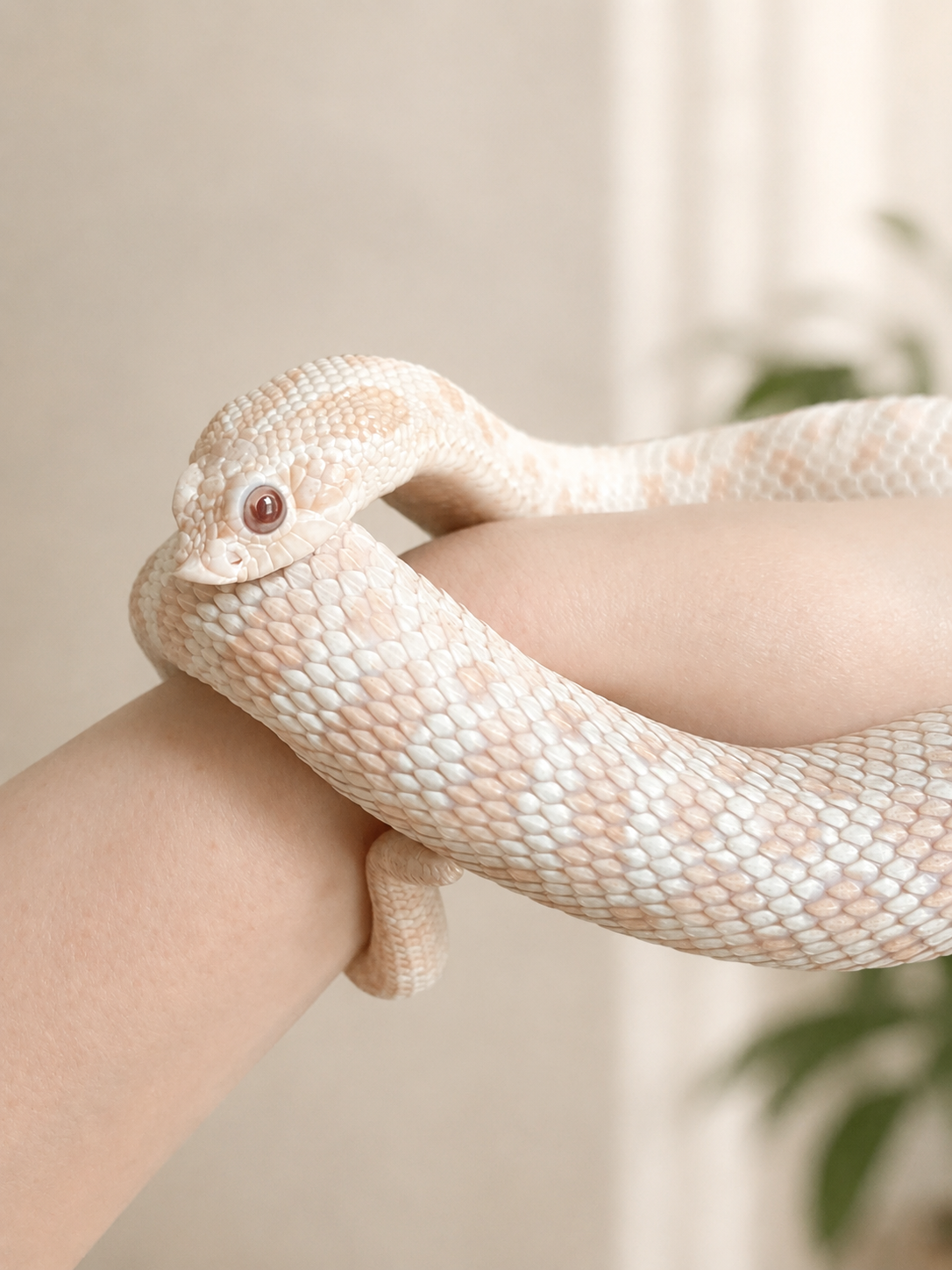
A snow western hognose is white with the faintest ghost of patterning visible in certain lights. The combination of albino and axanthic removes both the melanin and the yellow pigment simultaneously, leaving an animal that looks like it was sketched in pencil on white paper. They're striking in a way that photographs well but doesn't fully prepare you for seeing one in person for the first time.
We had been through four days of generator logistics and temperature anxiety and blanket insulation to get to this moment. We looked at the two snow hatchlings and made a decision without much deliberation at all.
We were keeping one.
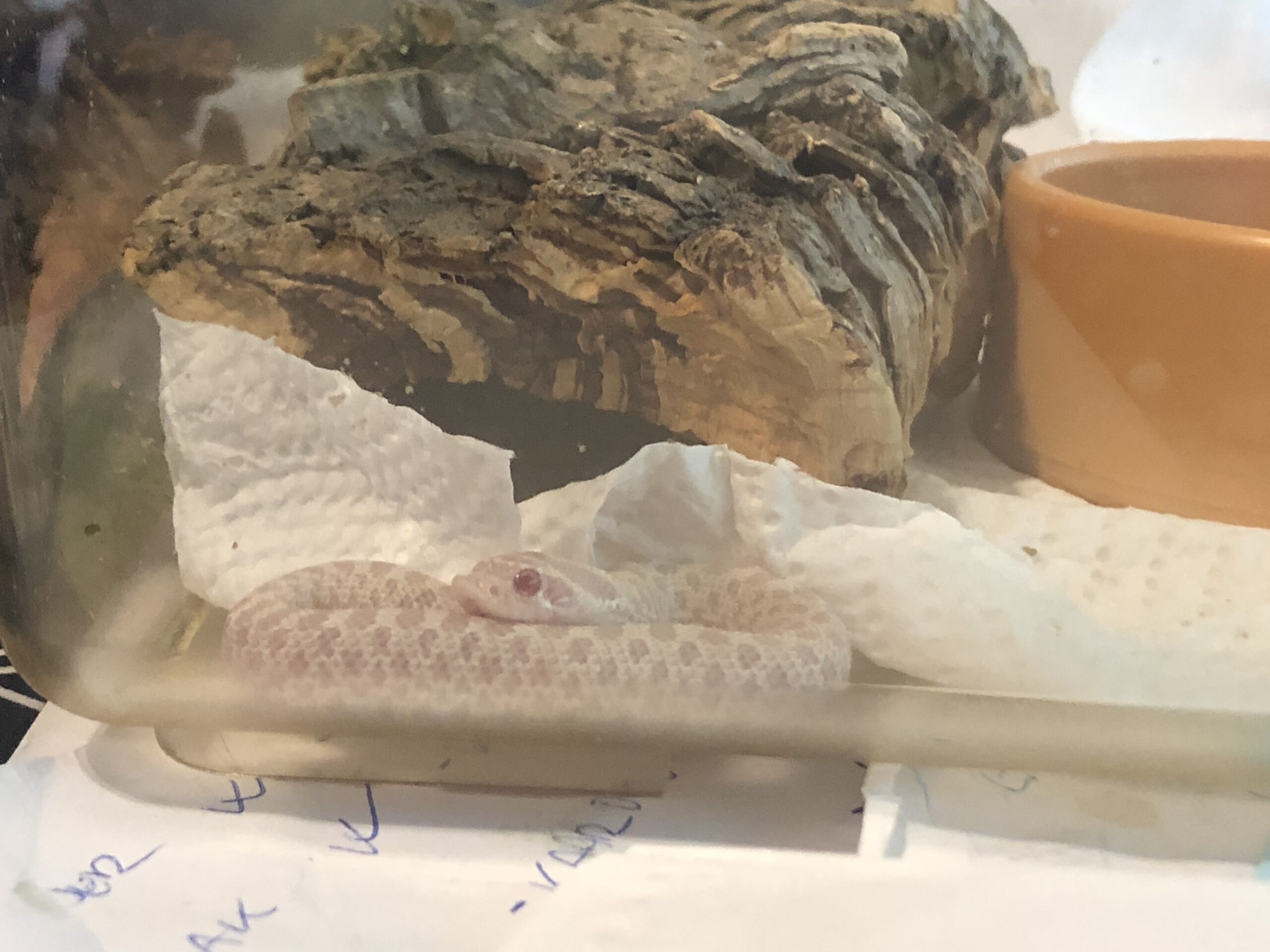
A snow morph needs a name. We had several options and none of them felt quite right until we stopped trying to think of something clever and just thought about what the past few weeks had actually been.
A storm. Flooding across the country. Power cuts and generator runs and two blankets over an incubator every night for four days. The clutch that almost didn't make it, hatching six days after the power came back, producing two snows we hadn't quite dared to expect.
Nimbus. The Latin word for storm cloud, and the meteorological term for the type of cloud associated with heavy rain.
It wasn't planned. It was just immediately, obviously right.
She's been with us since that summer, growing steadily and developing the quiet confidence that well handled hognose snakes tend to settle into over time. Her coloration has only become more striking as she's matured, that particular white that catches light differently depending on the angle, with just enough patterning to remind you there's a hognose under there somewhere.
She doesn't know anything about generators or blankets or power cuts. She just knows she has a warm enclosure, regular meals, and a name that suited her before she was even out of the egg.
We think that's enough.
You must be logged in to post a comment.

No comments yet — be the first.