
We knew she was close.
Everything pointed to it. Her timeline from ovulation, the post-ovulation shed, the way she'd been spending more and more time pressed against the lay box without quite going in yet. We'd been checking on her morning and evening for days, doing the mental calculations, trying to narrow down the window. And then, because we needed a single night away to actually breathe for the first time in weeks, we decided she could probably hold off for 24 hours.
Well, she could not hold off for 24 hours.
The message came through on the morning of day 65: "She's laying."
We packed up and drove home.
By the time we got back, Bajsa was still coiled in the lay box, visibly rounded in the mid-section, clearly not finished. We could see eggs partially buried in the substrate. Roughly seven, though the arrangement made it difficult to count precisely, but it was obvious more were still inside her.
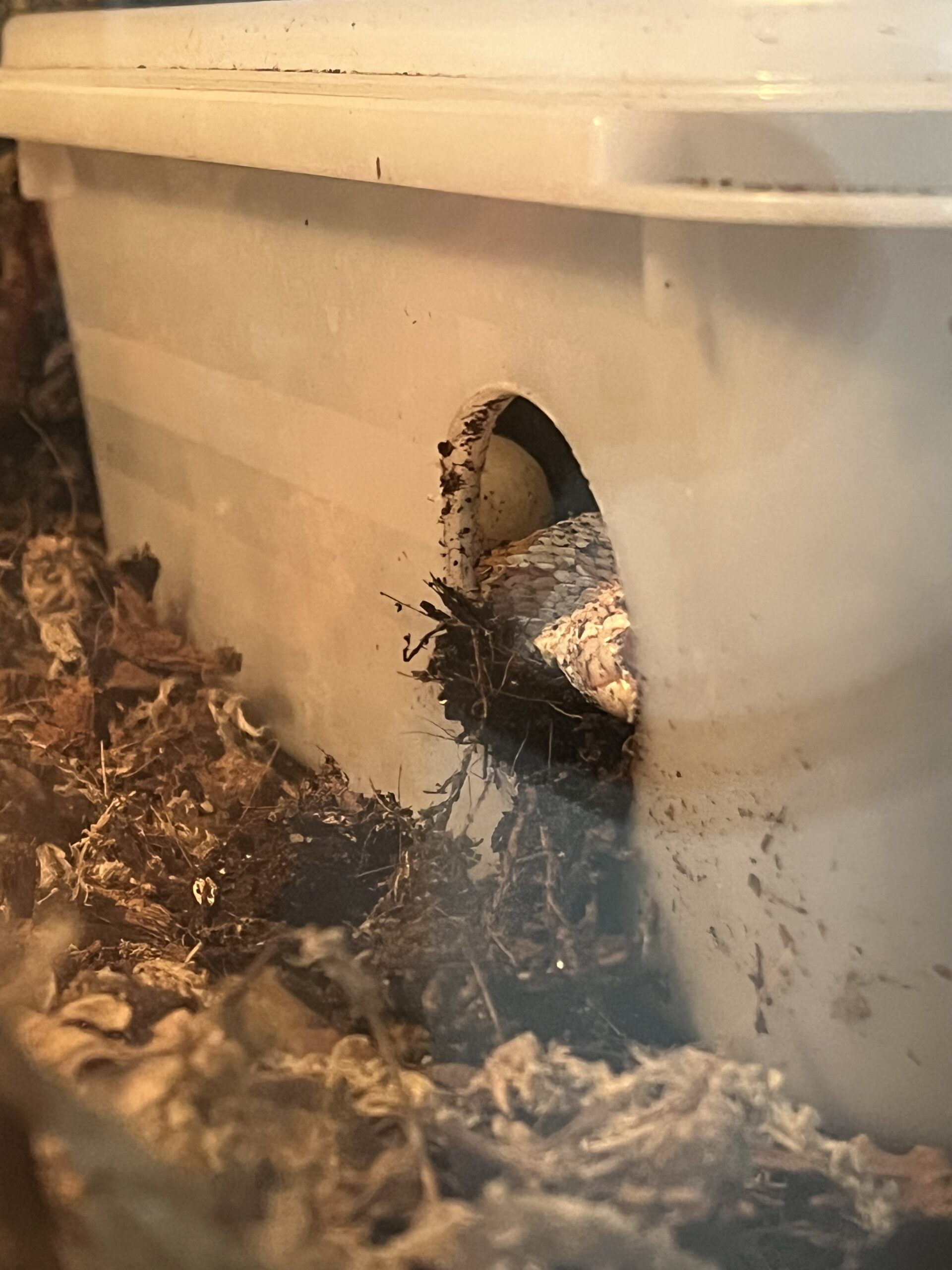
The instinct is to jump straight in and start assessing, but that's the wrong move with a female who is mid-lay. Disturbing a snake during egg deposition is stressful for the animal and can sometimes cause her to abandon the process before she's done. We left her alone, kept the room quiet, and waited.
By late afternoon, she had settled, and we made the call to move her out gently and bring the lay box out for processing.
We candled each egg individually before transferring them to the incubation box. Candling — shining a focused light through the egg in a darkened room — lets you see inside the shell well enough to assess fertility. A viable egg at this stage will show a small embryo and, often, a visible network of blood vessels radiating outward from it. An infertile slug, by contrast, looks uniform and dull, no structure, no vascularization, usually slightly yellowish and softer than the fertile eggs.
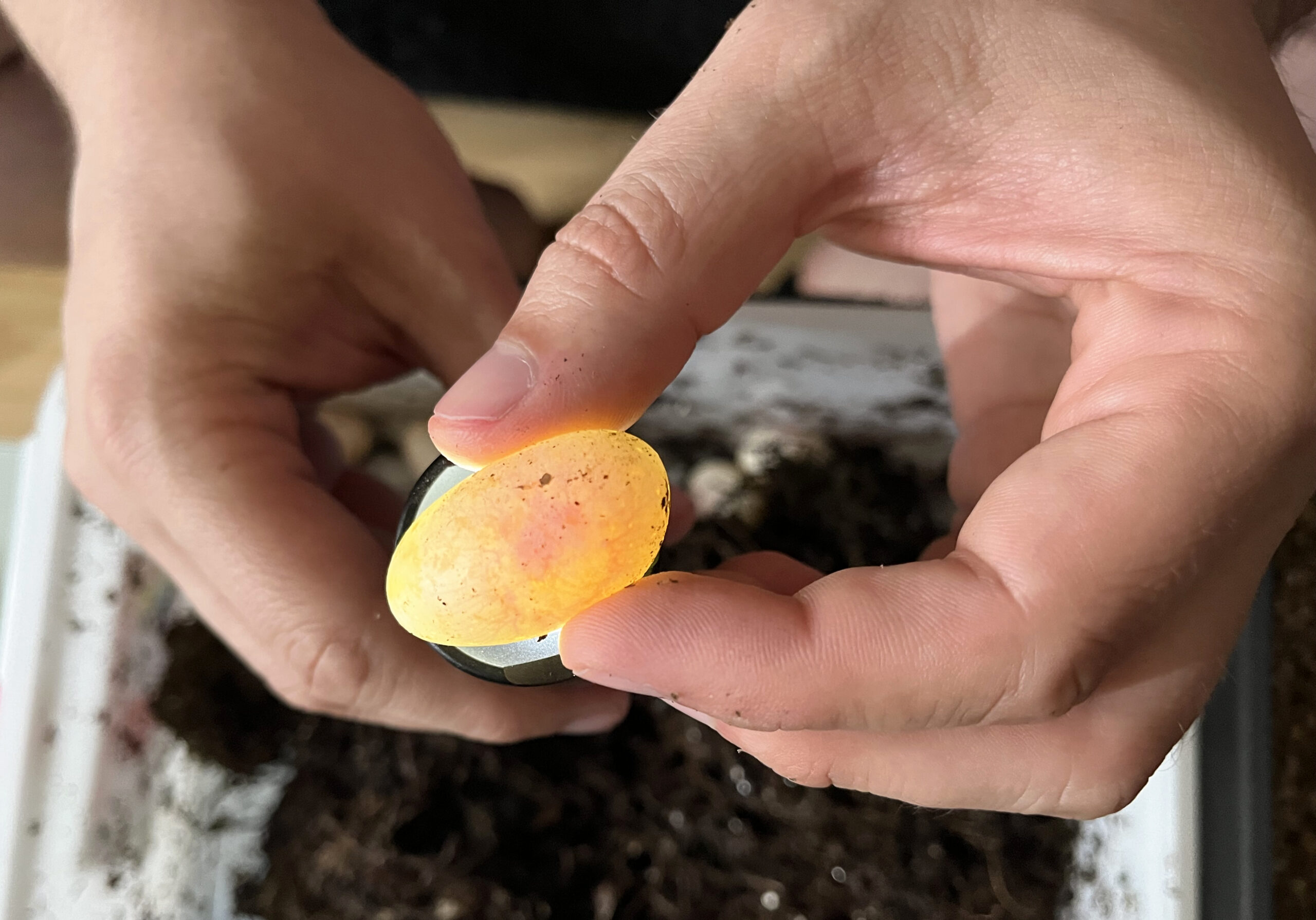
One thing worth emphasizing for anyone doing this for the first time: once you've identified the embryo's position, that orientation is fixed. Reptile eggs must be incubated with the embryo facing upward, and rotating the egg after the embryo has settled against the shell can cause it to detach, which is fatal. We mark the top of each egg with a soft pencil before moving it, and from that point on, the marked side stays up. Always.
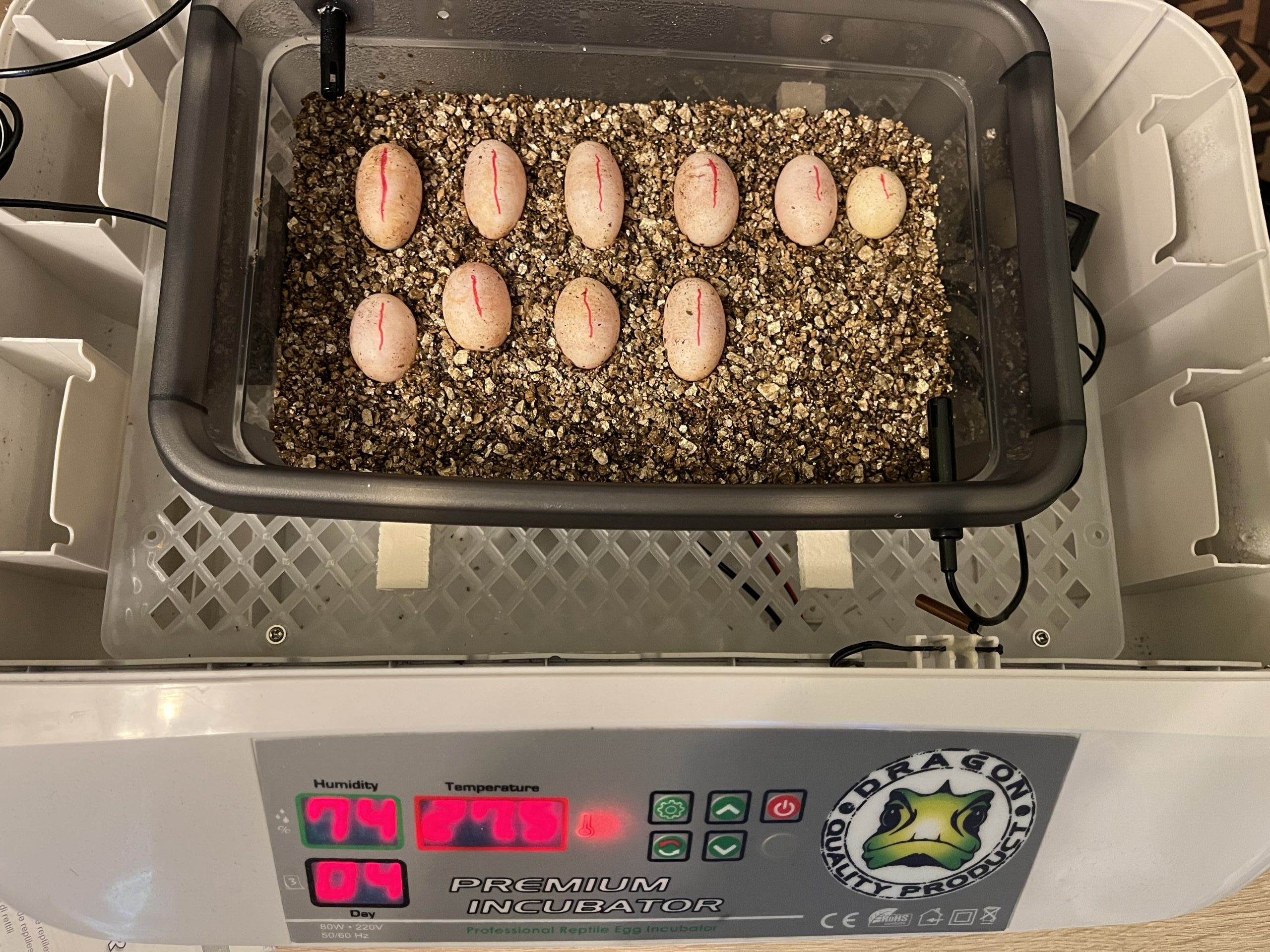
By the time we'd worked through everything, we had ten eggs that looked good and three slugs. The slugs were set aside. The ten fertile eggs went into the incubation box on slightly moist vermiculite, sealed up to maintain humidity, and moved into the incubator.
And then we noticed that Bajsa still looked like she had more eggs inside.
We returned the lay box to the terrarium and Bajsa went straight in without any hesitation, which felt like a good sign. A female who is done laying typically shows little interest in the box once it's been removed. She settled in, we turned the lights down, and left her for the night.
The next morning, she was out of the lay box and noticeably slimmer through the back half of her body (the area where developing eggs sit before deposition). The kind of slim that means she had finished. We opened the lay box expecting to find the remaining eggs.
We dug through the substrate carefully.
Then we dug more carefully.
Then we checked every corner.
Nothing. No eggs. Just a thoroughly rearranged lay box and Bajsa nearby, looking entirely unbothered and, if we're being honest, slightly smug.
It took a moment for the obvious explanation to land.
She ate them!
It's not common, but it's documented, and it's more likely under certain conditions than others. Females who are highly food-motivated, first-time layers, or animals that weren't fully separated from their eggs quickly enough after laying are the most frequent candidates. The behavior is thought to be partly instinctive. In the wild, an egg that a female senses is non-viable may be consumed as a way of recouping some of the nutritional investment that went into producing it. Whether captive females are making that distinction or simply responding to the presence of something that smells edible is harder to say.
What's clear is that prompt egg removal matters. The standard advice exists for exactly this reason: get the eggs out of the enclosure as soon as the female has finished laying, or as soon as you can do so without disrupting an ongoing lay. Every hour they remain accessible is an hour something can go wrong.
Bajsa had never done this before. But if you know Bajsa the fact that she eventually ate something that was technically available to her is probably the least surprising thing she has ever done. We named her Bajsa for a reason. In our language, it's essentially an affectionate term for someone who loves food above all else, someone who eats with great enthusiasm and zero restraint. She has lived up to that name at every opportunity, and apparently she wasn't about to stop now.
The ten eggs we transferred are developing under stable conditions: consistent temperature, controlled humidity, minimal disturbance. Eight of them look exactly as you'd want. Firm, well formed, holding their shape.
Two are worth monitoring more closely. One is noticeably smaller than the rest, which doesn't automatically rule out viability but does put it in a different category from the others. The second looks slightly translucent in a way that suggests the shell quality may not be ideal. A "wet" appearance that can sometimes indicate poor structural integrity or reduced viability. We're not writing either of them off, but we're watching them with more attention than the other eight.
We'll candle again in a few weeks to see how development is progressing across the clutch.
Here's the other thread running through this season that remains unresolved: we still don't know who sired this clutch.
Bajsa was paired with Albi first. Three days together, no confirmed lock, but the possibility of an unobserved mating. Then Hoggy, whose lock was confirmed. Female hognose snakes can store viable sperm from multiple males simultaneously, and it's genuinely possible for eggs within a single clutch to have different fathers. A phenomenon called heteropaternity that's been documented in snakes and various other reptile species.
So when these eggs hatch, we'll be looking closely. The morph breakdown of the hatchlings may point clearly toward one male or the other or it may leave the question open. Either way, the answer is somewhere inside those ten eggs, developing quietly in the incubator while we wait.
Ten eggs incubating. Two under closer watch. A confirmed egg-eater added to Bajsa's long list of personality traits. And a paternity mystery that won't resolve itself for another couple of months.
Bajsa herself is recovering well. Eating again, moving normally, acting as though none of this was remotely out of the ordinary for her. Which, given her track record, it probably wasn't.
Updates will follow as incubation progresses. If last season is anything to go by, hatch day will arrive exactly when we least expect it.
Oh, and if you're wondering how we know she ate them... We found out the same way you find out most things with snakes. We saw it in her next bowel movement. Bajsa really commits to whatever she does.
You must be logged in to post a comment.

No comments yet — be the first.