
If you've never watched two hognose snakes figure each other out during breeding season, it's hard to describe just how weirdly captivating it is. There's no dramatic display, no loud signaling, nothing that obviously screams this is a big moment. It's subtle. Chemical. Almost secretive. And yet, when you know what you're looking at, the whole thing unfolds like a slow, perfectly choreographed sequence — one cue triggering the next, each behavior building on the last.
This post is my attempt to break that sequence down properly. We'll cover how western hognose mating actually works from a biological standpoint, what behaviors to look for at each stage, and how everything played out this season with our own pair — Bajsa and Albi. I'll also walk through what happens after a successful mating, because the weeks that follow are just as important as the lock itself, even if they're a lot less exciting to watch.
Before getting into our experience, it's worth understanding what's actually happening during a hognose breeding introduction because a lot of it is invisible.
Western hognose snakes don't use visual displays or vocalizations to communicate reproductive readiness. Everything happens through pheromones — chemical signals picked up by the tongue and processed through the Jacobson's organ on the roof of the mouth. This is why you'll see males doing so much tongue-flicking during introductions. They're not just exploring the space. They're reading a chemical profile that tells them whether the female is receptive, what stage of her cycle she's in, and whether it's worth pursuing courtship at all.
Females produce different pheromone signatures depending on where they are in their reproductive cycle. A non-receptive female smells different from a receptive one, and males can tell the difference almost immediately. This is also why pairing timing matters so much. Introducing a male to a female who isn't hormonally ready often results in nothing happening, or worse, the female becoming defensive.
The most reliable visible sign that a female is receptive is the breeding twitch — a rhythmic, wave-like vibration that runs through her entire body. It's unmistakable once you've seen it, and genuinely strange looking if you haven't. It's not a stress response or a defensive behavior. It's an active signal directed at the male, essentially confirming that the pheromone information he's picking up matches what he's seeing in her behavior.
Without the twitch, or at least strong pheromone receptivity, males often show only mild interest. They might follow briefly, then lose focus and wander. The twitch is what truly gets things moving.
Once a male has confirmed female receptivity and committed to courtship, he begins what's called draping — aligning his body alongside hers and maintaining close physical contact while working toward proper positioning. He'll move slowly, nudge her, pause, reassess, reposition. It can look like almost nothing is happening if you're expecting something more dramatic.
This phase can last anywhere from twenty minutes to several hours. Some pairs get there quickly; others take multiple sessions across different days before a lock occurs. Neither extreme is unusual. The male isn't being lazy or confused — he's working through a slow, tactile process of alignment that requires the female's cooperation as well as his own positioning.
One of the more striking things to observe during the final stages of courtship is what happens with the tails just before a lock occurs. Once the male has achieved rough alignment alongside the female, both animals begin moving their tails in a rapid, searching motion. The male is trying to locate the female's cloaca while the female's tail movements indicate whether she's cooperating with the process or resisting it. It looks almost frantic compared to the slow, deliberate pace of everything that came before — a sudden burst of activity after what might have been an hour of barely visible movement. If you've never seen it before it can look alarming, like something has gone wrong. It hasn't. It means things are going exactly right and a lock is likely imminent.
If everything aligns (timing, positioning, female cooperation) a lock follows. The male aligns his cloaca with the female's and inserts one hemipenis (males have two, but only use one per mating). Once locked, the pair can remain connected for anywhere from one hour to six or more.
Long locks are generally considered a good sign. There's a reason for the extended duration — it increases the likelihood of successful sperm transfer and reduces the chances of another male interrupting. Even in captivity where there's no rival male anywhere nearby, the biology doesn't know that.
After separation, both animals typically return to normal behavior within a short time, though males sometimes need a day or two before they're interested in food again.
Bajsa and Albi have been our breeding pair for a few seasons now, and while that experience means we have a general idea of what to expect, every year has its own personality. This one was no different.
Bajsa is our female. She's larger than Albi, confident to the point of being a little bossy, and extraordinarily food motivated — which is exactly the kind of personality that keeps you paying attention during introductions. A hungry or non-receptive female hognose won't necessarily wait to figure out what the smaller animal in her enclosure is there for. We've never had a serious incident, but we don't take chances either. Every introduction gets our full attention.
Albi is the opposite of Bajsa in temperament. He's calm, deliberate, and takes his time reading a situation before committing to anything. Honestly, for breeding purposes, that's ideal. An impulsive male who charges straight at an unreceptive female tends to end introductions quickly and badly.
When we introduced Albi into Bajsa's enclosure this season, the first thing she did was twitch. Not tentatively — clearly, rhythmically, immediately. It was one of those moments where you exhale a little, because the hardest variable (female receptivity) was already confirmed before Albi had even fully taken in his surroundings.
He didn't respond right away. Instead, he moved around the enclosure slowly, tongue flicking constantly, taking in everything. This is completely typical of him and, honestly, the right approach. Once he'd had enough time to read the room, he oriented toward Bajsa and began courtship — slow body contact, gradual alignment, the classic draping behavior.
The first day didn't produce a lock. They spent a long stretch in the courtship phase without quite getting there. This happens. Sometimes timing between animals needs a session or two to sync up properly, even with a proven pair. What was reassuring was that there was no aggression whatsoever, and they ended up resting together overnight. In our experience, a calm overnight together is often a quiet indicator that things are heading in the right direction.
The next morning, it clicked. A successful lock occurred mid-morning and held for just under six hours. Six hours is on the longer side, but well within normal range for western hognose snakes, and we were happy to see it.
After they separated naturally, Albi was carefully removed and given a warm soak. His hemipenes were still slightly visible — this can occasionally happen after a lock and isn't a cause for alarm, but a warm soak helps the muscles relax and allows full retraction comfortably. Everything resolved without any issue.
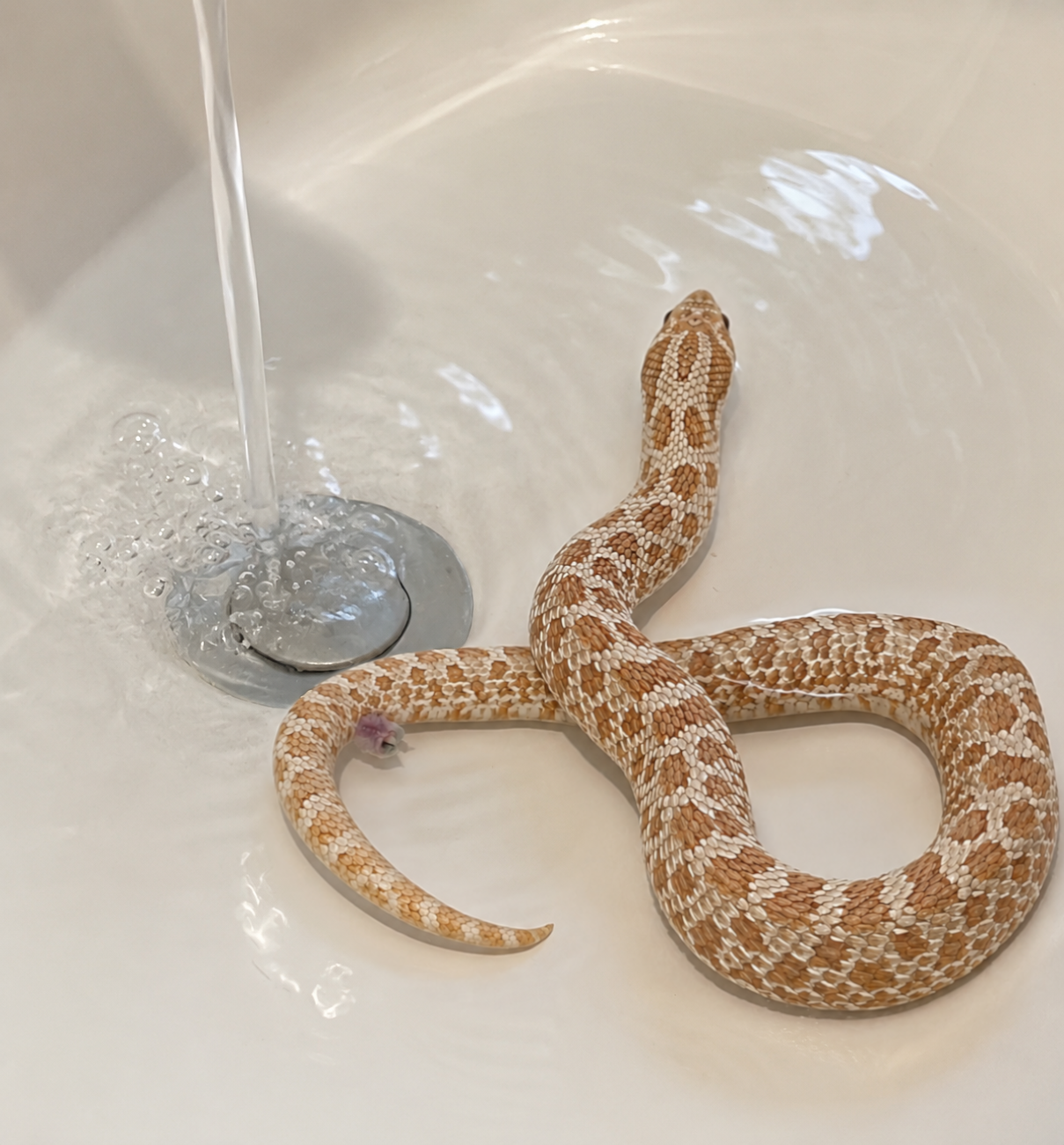
The lock is the milestone everyone waits for, but in a lot of ways, the weeks that follow are where the real work happens. It just all takes place inside Bajsa's body rather than in front of us.
If fertilization was successful, Bajsa will enter the gravid stage — developing eggs internally. Early signs of this are easy to miss. Some females gradually reduce feeding during this period, others continue eating normally for several more weeks. Over time, a slight but visible fullness develops in the lower third of the body as the eggs take shape, and most females become noticeably calmer and more sedentary than usual.
It's worth noting that western hognose snakes are oviparous — they lay eggs rather than giving birth to live young (which some snake species do). The eggs develop internally to a point, but they're laid and incubated externally. The female doesn't regulate incubation temperature herself the way a bird would; that responsibility shifts to the keeper once eggs are deposited.
Egg production is metabolically expensive, and calcium demand goes up significantly during the gravid period. Eggshells require calcium, and if the female's diet doesn't provide enough, her body will pull it from her own bone density which is obviously not ideal.
During this phase, we increase calcium supplementation slightly through regular feedings. Nothing excessive just consistent, intentional support to keep up with what her body is asking for. This helps reduce the risk of soft-shelled eggs and egg binding (dystocia), which is a potentially serious condition where a female struggles to pass eggs.
Of everything that happens between mating and egg laying, the pre lay shed is the milestone that tells you to start paying close attention. It's a full body shed that typically occurs four to ten days before the female deposits her eggs, and it's one of the most reliable natural indicators in reptile keeping.
After this shed, most females stop accepting food entirely and begin moving around their enclosure more actively — searching for a suitable laying site. This is the point where having a proper lay box in place matters. A lay box is simply a secure, enclosed space with a humid substrate (coconut fiber or slightly damp sphagnum moss work well) that gives the female somewhere she feels safe enough to deposit her eggs. Without one, females sometimes lay in the water bowl, against the glass, or in other places that aren't ideal for egg survival.
Once the lay box is in and she's in search mode, you're usually days away from eggs.
If everything develops as expected, we're looking at Bajsa laying somewhere in the seven to nine week range from the date of the lock. After that, the eggs go into an incubator, and roughly sixty days later — all going well — we should have hatchlings.
We'll be keeping a close eye on her and sharing updates as things progress. The pre lay shed is the next major thing we're watching for, and when it happens, we'll post about it.
If you're new to western hognose breeding or just following along — welcome. There's a lot more of this story still to tell.
And as always - stay happy, stay curious, and give your hoggie a gentle boop from me.
You must be logged in to post a comment.

No comments yet — be the first.