
The excitement of bringing home a new western hognose snake is hard to overstate. They're small, they're charismatic, and every instinct you have is telling you to pick them up immediately and not put them down for several hours.
Here's the thing though: while you're excited, your new snake is almost certainly not. The journey to your home — the travel container, the unfamiliar movement, the temperature fluctuations, the completely alien smells of a new environment — is a genuinely stressful experience for an animal that navigates the world primarily through chemical signals. Everything that made your home feel familiar and safe to you is precisely what makes it overwhelming to them right now.
The best thing you can do in the first days with a new hognose is also the hardest thing: leave it alone. Here's how to do that well, and what to do once the settling-in period is over.
If you have other reptiles at home, quarantine isn't a suggestion. It's the practice that keeps a single animal's unknown health status from becoming a collection-wide problem.
Even a snake from a clean, trusted source can be carrying something that hasn't produced visible symptoms yet. Parasites, bacterial infections, and some respiratory conditions have incubation periods that mean an animal can look and behave completely normally while still being a transmission risk. You won't know until time and observation tell you and that observation needs to happen in isolation.
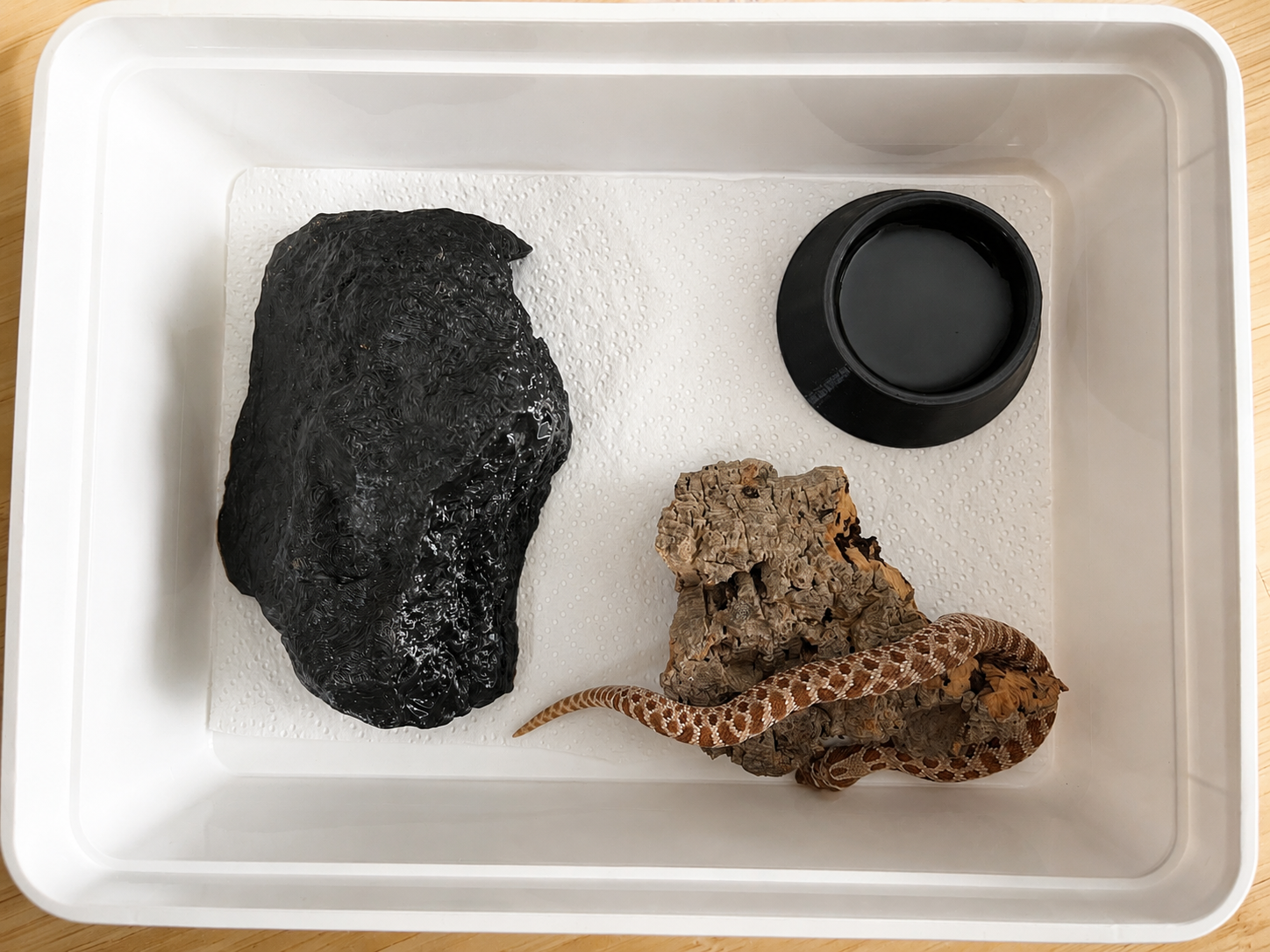
Quarantine setup: a separate room from your main collection, a simple plastic tub or basic enclosure, paper towel substrate. Paper towel is deliberately unglamorous — its value is that waste is immediately visible and easy to assess, and the whole setup can be cleaned thoroughly without substrate complicating the process. One hide on the warm end, one on the cool end, a water bowl. That's it. Simplicity is the point.
Keep a dedicated set of handling tools for the quarantine animal (feeding tongs, a hook if you use one) that don't cross over to your main collection. Wash your hands thoroughly after any contact with the quarantine snake or its enclosure before touching anything else. Pathogens travel on hands and clothing more easily than most people realize.
Minimum quarantine duration: 30 days. Sixty to ninety is better, and worth doing if you have any reason for caution. We have a full post on quarantine procedures that goes into much more detail if you want the complete picture.
This is the instruction new keepers find hardest to follow, and it's also the one that matters most in those first weeks.
Your new snake needs time to establish a baseline sense of security in its new environment before anything is asked of it. That process takes longer than most people expect, and it's disrupted every time the animal is picked up and has to process a new set of stimuli. A snake that's being handled regularly before it's settled isn't building trust with you, it's just being repeatedly stressed before it's had a chance to recover from the previous stress.
The practical rule: no handling for the first seven to fourteen days. After that, wait until the snake has eaten at least once before starting handling sessions. That first successful feed tells you the animal is comfortable enough in its environment to eat — which is a meaningful threshold, because snakes that don't feel secure don't eat.
When you do start handling, keep sessions short: five to ten minutes to begin with, a few times per week. Build from there based on how the snake responds, not on a fixed schedule. Some hognoses settle quickly and are relaxed within a few weeks. Others take considerably longer. The snake's behavior is the guide, not how long you've had it.
The instinct to feed a new animal immediately is understandable, but offering food too soon is usually counterproductive. A stressed snake won't eat, and a feeding refusal in the first days can create an association between the feeding process and an environment that doesn't yet feel safe, which makes subsequent feeding attempts harder, not easier.
For a healthy juvenile or adult hognose (roughly 30 grams or above) waiting seven to ten days before the first feeding attempt is the standard recommendation, and it's a good one. During this time the snake is adjusting, establishing scent familiarity with its new space, and beginning to feel secure enough to start behaving normally.
When you do offer food: frozen-thawed prey only, sized appropriately for the snake (roughly the same width as the animal's widest point), placed in the enclosure and left alone. Don't watch, don't hover, don't check every fifteen minutes. Leave it for a few hours, then look. If it wasn't taken, remove it and try again in a week. A refusal in the first few feeding attempts is normal and not a crisis. Patience here prevents a lot of unnecessary stress for both of you.
If your snake is a very small hatchling or arrived underweight, use your judgment on timing. Smaller animals have less reserve to draw on. But even then, a week or two is usually fine for an otherwise healthy animal.
There's a temptation to give a new snake an elaborate, fully decorated enclosure from day one. Resist it, at least during quarantine and the initial settling period.
A complex environment with lots of décor isn't enriching for a stressed animal, it's just more stimuli to process at a time when the animal is already overwhelmed. A simple setup with one warm hide, one cool hide, a water dish, and clean substrate gives the snake everything it needs and nothing it doesn't. Once it's settled, eating consistently, and showing normal exploratory behavior, you can begin adding furniture and complexity.
The warm side of the enclosure should sit around 30–32°C (85–90°F) at the surface, with the cool side at 22–24°C (72–76°F). Verify these with a thermometer or heat gun rather than assuming. The difference between what you think the temperature is and what it actually is at substrate level can be significant, and a snake that can't thermoregulate properly won't settle or eat well regardless of everything else.
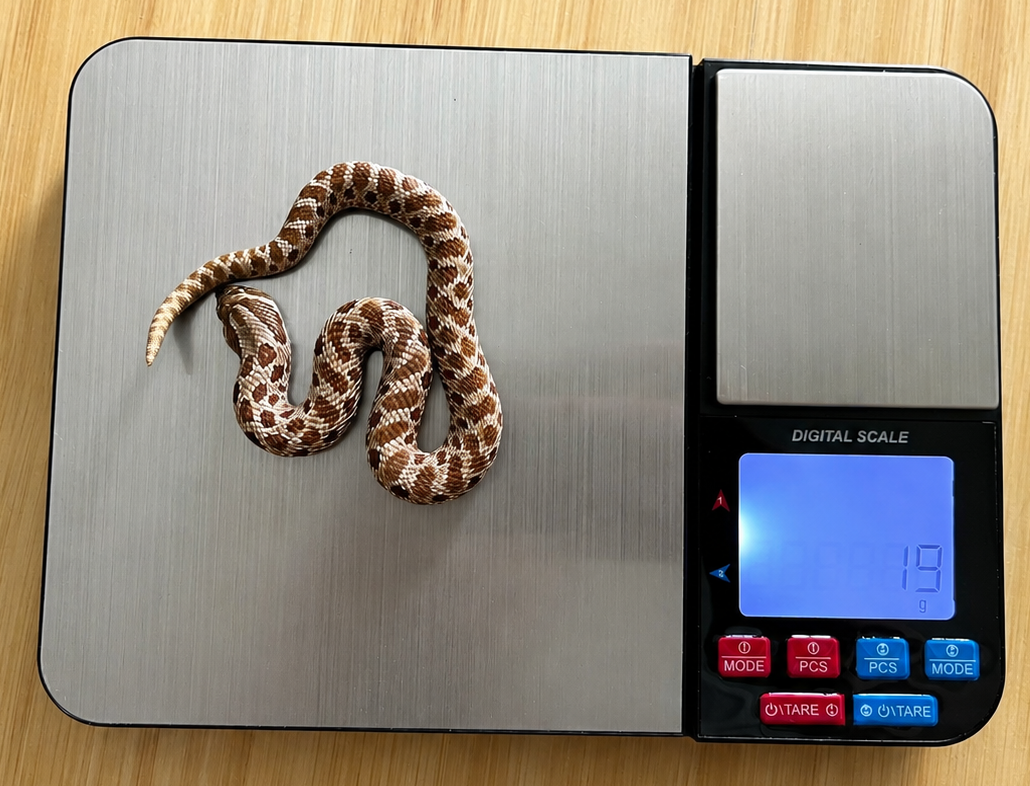
Start a log when the snake arrives and keep it updated consistently. What you're tracking: feeding attempts and outcomes, waste observations (consistency, frequency, anything unusual), shed cycles, weight if you have a scale, and any behavioral notes worth recording.
This might feel like unnecessary admin when everything is going fine. It becomes invaluable when something changes — because the log gives you a baseline to compare against, and baselines are only useful if you established them during the normal days. "She seemed off today" is much harder to act on than "she's lost four grams over three weeks and skipped two consecutive feeds." One is a feeling; the other is data.
Weight in particular is worth tracking regularly. A snake that's eating but not gaining weight, or slowly losing weight between feeds, is telling you something important, and you can only see that pattern if you've been measuring. We learned this from experience with our own animals, and we wouldn't skip it again.
Knowing when a snake has moved past the adjustment phase and into genuine comfort with its environment is worth understanding, because the signs aren't always dramatic.
A settled hognose is one that eats reliably when offered, moves around its enclosure with purpose during its active periods (usually dawn and dusk), investigates new objects or changes to the enclosure with curiosity rather than alarm, and tolerates handling without constant musking, striking, or trying to escape. These behaviors don't all appear at once, they accumulate gradually as the snake becomes more confident.
A snake that's still musking every time you open the tub, refusing food consistently, or spending all its time motionless in a single hide isn't settled yet, regardless of how long it's been there. Keep the environment stable, keep handling minimal, keep the routine consistent, and give it more time.
Everything you do — or don't do — in the first weeks with a new hognose shapes what kind of animal it becomes in your care. A snake that's given adequate time to adjust, that experiences its first feeds in a calm and stable environment, and that's handled gradually and with good technique will be a fundamentally different animal to work with six months from now than one that was pushed too hard too soon.
The patience required in those early weeks isn't really about the snake. It's about you, about resisting the understandable impulse to engage with a new animal before it's ready. It's harder than it sounds, and it's also the most important thing you can do.
After that first successful feed, things open up quickly. The handling sessions start. The personality begins to show. The absurd hognose dramatics make their appearance. It's worth waiting for.
And as always - stay happy, stay curious, and give your hoggie a gentle boop from me.
You must be logged in to post a comment.

No comments yet — be the first.